Autobayng News Team


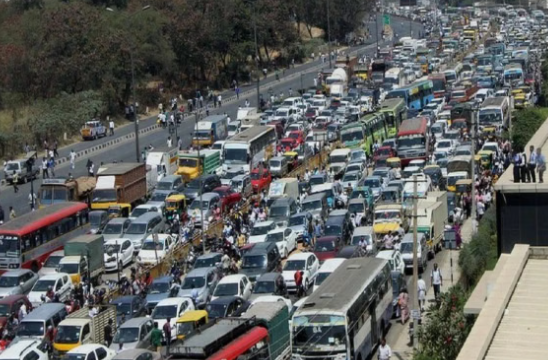 To tackle congestion, the 5th State Finance Commission has recommended a congestion fee on high-traffic corridors such as ORR.
“>
Vehicle count in Bengaluru city breached 1.2 crore as of March 31, 2026, straining an already-stretched urban mobility system. This translates to 900 vehicles for every kilometre of city road.
In 2025-26 alone, 7.9 lakh vehicles were added — more than 2,100 a day on average — compared with 7.2 lakh the previous year. The surge has added to congestion across the city, even as the road network has seen limited expansion. Greater Bengaluru Authority has a total road length of 14,063km across its five corporations.
In the absence of adequate public transport, dependence on private vehicles continues to rise. Two-wheelers dominate this growth, with 5.2 lakh added in 2025–26, alongside 1.5 lakh cars. Among the city corporations, Central (1,613 km) & East (1,759 km) have the smallest road networks. Yet, they carry heaviest traffic volumes. Key IT corridors such as ORR and Whitefield, largely in the eastern corporation, are expected to see worsening congestion.In contrast, north Bengaluru has the largest road network at 3,951km, followed by West (3,753km) and South (2,985km).
Adding to the pressure are thousands of vehicles entering the city daily from neighbouring districts and states. Yet, public transport has not expanded at the desired pace. BMTC fleet has remained at 7,000 buses for over a decade, serving 48 lakh passengers daily. The Metro, operational since 2011, is yet to cross the 100km network mark, though it carries over 10 lakh commuters each day.
Prof Ashish Verma, convener of IISc Sustainable Transportation Lab, said the city is at a point where infrastructure additions are no longer sufficient. “After the war in West Asia, fuel shocks are being felt across the globe. India is also impacted. Sooner or later, petrol and diesel prices will have a larger impact on motorists. This is the right time to undertake a major policy shift that promotes public transport systems.”The impact is not limited to traffic delays. Dr Ravindra Mehta, an interventional pulmonologist and founder, Vaayu Chest & Sleep Specialists, warned that rising vehicle numbers are directly affecting public health. Continuous exposure to emissions, especially at congested junctions, is contributing to respiratory illnesses ranging from allergies to chronic conditions such as asthma and bronchitis. Children face higher long-term risks, he added.To tackle congestion, the 5th State Finance Commission has recommended a congestion fee on high-traffic corridors such as ORR. While the proposal has been discussed in the past, it remains unimplemented.
The govt has set a revenue target of ₹15,500 crore for the transport department this fiscal, signalling continued reliance on taxes from new vehicle registrations. A proposal to withdraw tax exemptions for electric cars has also drawn criticism, with stakeholders arguing it could slow the shift to cleaner mobility.
Join the community of 2M+ industry professionals.
Subscribe to Newsletter to get latest insights & analysis in your inbox.
All about ETAuto industry right on your smartphone!
- Download the ETAuto App and get the Realtime updates and Save your favourite articles.