Autobayng News Team

Highlights
- Automakers are seeking incentives and fuel-price support for flex-fuel vehicles (FFVs), arguing that lower fuel economy on ethanol blends could hurt consumer adoption.
- India’s FFV push is accelerating, with OEMs launching new models, but widespread adoption depends on higher-ethanol fuel availability, competitive pricing, and expanded refuelling infrastructure.
- The industry has raised concerns over proposed CAFE III norms, saying reduced FFV regulatory credits could weaken the business case for investing in flex-fuel technology.
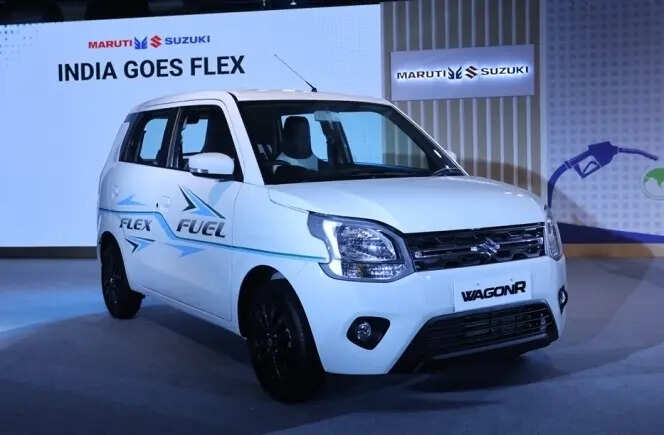 flex-fuel vehicles (FFVs) in India has reached a fever pitch in recent weeks. Driven by the government’s push to aggressively increase ethanol blending in petrol, original equipment manufacturers (OEMs) have started pulling the wraps off their latest FFV prototypes.
Maruti Suzuki India recently debuted a flex-fuel WagonR capable of running on any ethanol-petrol blend from E20 up to E100 and has already delivered this vehicle to 13 buyers.
On the two-wheeler front, Hero MotoCorp has introduced FFV variants of its mass-market 100 cc motorcycles—the Splendor+ and HF Deluxe—which can operate on ethanol blends starting from E20. Several other automakers have similar FFV models at various stages of development.
By definition, an FFV can seamlessly run on multiple fuel types mixed in varying ratios, including E20 (20 per cent ethanol), E85 (85 per cent ethanol), or E100 (pure ethanol).
Currently, E20 serves as the standard mono-fuel available at Indian fuel stations, though testing is actively underway to roll out higher ethanol blends across the country. The government has already slashed duties on higher blends, signalling its resolve to push for more and more ethanol in petrol. Nitin Gadkari, the minister of Road Transport & Highways, is already speaking of approving E100 or pure ethanol.
We need fuel price reduction to make FFVs attractive to buyers and a 20 per cent correction has already been announcedSenior automobile industry official
Industry demands fiscal support
While automakers fully support the government’s green push to bolster national energy security, they have also started demanding fiscal assistance. Highlighting the economic challenges, a senior automobile industry official noted that manufacturers will require targeted incentives to compensate consumers for the lower fuel economy inherent to ethanol.
“We need fuel price reduction to make FFVs attractive to buyers and a 20 per cent correction has already been announced. The industry also needs other incentives to bring down the cost of these vehicles for the buyers. There is the acquisition cost and then the ownership cost, both will have to be reduced for FFVs to find favour with the buyers,” this person said, requesting anonymity.
Dismissing any expectations for direct purchase subsidies—similar to those currently being granted to electric two- and three-wheelers among other vehicle categories—the official emphasised that the government needs to find alternative pathways to incentivise adoption without relying on traditional subsidy models.
The automotive sector appears to be looking at the recently launched ‘Naya Safar’ scrappage scheme for commercial buses and trucks as a viable blueprint. That programme utilises a mix of limited-period interest subventions, monthly fuel vouchers for scrapped vehicles, and lump-sum payouts for new EV adopters.
The unnamed industry source suggested a comparable framework could be adapted for FFVs, noting that automakers have already communicated these proposals to policymakers.
As for direct tax relief, bridging the gap is complicated. Since the rollout of GST 2.0 last September, the automotive tax rate stands at 18 per cent, while the next lower tier sits at 5 per cent—a bracket strictly reserved for electric vehicles.
“The government may not want to bring parity between FFVs and EVs in taxation, which is why we are seeking incentives without an outright subsidy or tax concession mechanism,” he said.
Besides wider availability of higher ethanol blended fuel, there must also be a good industry portfolio of vehicles for the segment to see any inflectionAnalyst, Mumbai-based brokerage
A long road ahead
Market experts urge caution, noting that India is still in the nascent stages of its flex-fuel transition. An analyst at a Mumbai-based brokerage pointed out that fuels exceeding a 20 per cent ethanol blend are not yet commercially accessible to the public.
“Besides wider availability of higher ethanol blended fuel, there must also be a good industry portfolio of vehicles for the segment to see any inflection. Of course, the price of the fuel must also support the inherent mileage loss”.
The analyst added that the trajectory of the EV market will heavily influence the fate of flex fuels, remarking that if the former were to happen quickly, then “lesser effort would be needed towards flex fuel vehicles”.
Echoing this sentiment, the first industry official noted that manufacturers are maintaining a watch-and-wait approach to consumer demand, while acknowledging the fiscal strain on the government, which may find it tough to foot the bill of incentivising FFVs on top of the subsidy schemes already operational to spur the electric vehicle demand.
If regulatory frameworks fail to reward automakers for the financial risks of developing FFVs, building a business case for mass production becomes highly challengingIndustry viewpoint
The regulatory bottleneck: CAFE III norms
Automakers are also grappling with tightening Corporate Average Fuel Economy (CAFE) regulations, which impose heavy penalties on companies whose overall fleet emissions exceed designated thresholds.
The upcoming CAFE III guidelines, scheduled to take effect next April, present significant roadblocks for manufacturers. The new proposal aims to slash regulatory “super credits” for FFVs down to 1.1 from the previous 1.5.
The industry argues this move is counterproductive, given that emission frameworks officially recognise ethanol as a carbon-neutral fuel and count it as a 100 per cent replacement for petrol. If regulatory frameworks fail to reward automakers for the financial risks of developing FFVs, building a business case for mass production becomes highly challenging.
Furthermore, OEMs stress that expanding the physical refueling infrastructure is critical, noting that improved availability is central to the promotion of FFVs as a viable alternative going forward.
Finally, there are lingering technical anxieties regarding the government’s plan to simultaneously raise the baseline ethanol blend beyond 20 per cent. Moving too fast could trigger severe engine damage in older, non-compliant vehicles currently on the road. To safeguard existing car owners and maintain consumer confidence, the automotive industry has urged the government to ensure the continued availability of standard E20 petrol even as higher blends are integrated into the market.
Join the community of 2M+ industry professionals.
Subscribe to Newsletter to get latest insights & analysis in your inbox.
All about ETAuto industry right on your smartphone!
- Download the ETAuto App and get the Realtime updates and Save your favourite articles.