

 Autobayng News Team

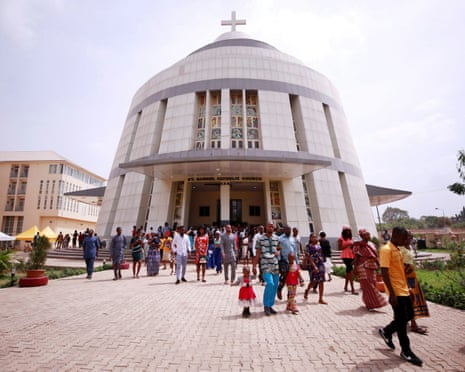


Parts of the US right have for years been amplifying claims that Christians face violence in Nigeria, a notion the US president has helped to encourage
After spending weeks accusing Nigeria’s government of failing to tackle the persecution of Christians, Donald Trump announced a series of strikes on the west African country on Christmas Day.
The strikes, targeting Islamic State militants in the country’s north, mark the latest overseas military intervention from Trump, who campaigned on a promise to extricate the US from decades of “endless wars” during his 2024 run for president.
What do we know about the strikes?
In his announcement, Trump said the strikes were aimed at Islamic State militants who have been “targeting and viciously killing, primarily, innocent Christians, at levels not seen for many years, and even Centuries!”
A Defense Department official told the Associated Press that the US worked with Nigeria to carry out the strikes, and that they’d been approved by that country’s government. Nigeria’s ministry of foreign affairs said the cooperation included exchanges of intelligence and strategic coordination.
Why has Trump targeted Nigeria?
Parts of the US right have for years been amplifying claims that Christians are facing persecution in Nigeria. In September, Republican senator Ted Cruz pushed to sanction Nigerian officials who “facilitate violence against Christians and other religious minorities, including by Islamist terrorist groups”.
Claims that Christians face religious persecution overseas have become a major motivating force Trump’s base – and the US president counts evangelical Christians as among his most enthusiastic supporters.
Earlier this year he appeared to act on some of these concerns by designating Nigeria a “country of particular concern” under the US International Religious Freedom Act, which followed weeks of lobbying by American lawmakers and conservative Christian groups. Soon after, he ordered the Pentagon to begin planning for potential military action in the country. At the time, the president said he might go in “guns-a-blazing” if the Nigerian government continued to “allow the killing of Christians”.
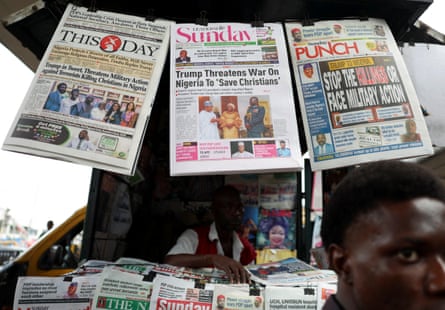
Is there religious persecution in Nigeria?
In the past, Nigeria’s government has responded to Trump’s criticisms by saying that people of many faiths, not just Christians, suffer at the hands of extremists groups who operate throughout the country.
Nigeria is officially secular but almost evenly divided between Muslims (53%) and Christians (45%), with the remaining population practising African traditional religions. Violence against Christians has drawn significant international attention, and is often framed as religious persecution, but most analysts argue the situation is more complex and attacks can have varying motivations.
For example, deadly clashes between itinerant Muslim herders and predominantly Christian farming communities are rooted in competition over land and water but exacerbated by religious and ethnic differences. Meanwhile, the kidnappings of priests is seen by many analysts as a trend driven more by money than religious hatred, as they are viewed as influential figures whose worshippers or organisations can mobilise funds quickly.
What does the Nigerian government say?
After Thursday’s strikes, Nigeria’s foreign ministry praised the cooperation with the US, but pointedly refused to acknowledge America’s actions had anything to do with the persecution of Christians.
“Terrorist violence in any form, whether directed at Christians, Muslims or other communities, remains an affront to Nigeria’s values and to international peace and security,” the ministry said in a statement.
Successive Nigerian governments have struggled to get a hold on the nation’s deteriorating security crisis, with thousands of people killed and hundreds more abducted in the past few years.
In the north-east, Boko Haram and its splinter groups such as Islamic State West Africa Province (Iswap) have waged an insurgency since 2009, killing tens of thousands and displacing millions. In the north-west, heavily armed criminal gangs – often labelled “bandits” – carry out mass kidnappings and raids that affect both Muslim and Christian communities.
Nigeria’s government has previously said in response to Trump’s criticisms that people of many faiths, not just Christians, have suffered at the hands of these groups.
Last month, Nigeria’s president, Bola Ahmed Tinubu, said the characterisation of Nigeria as a religiously intolerant country did not reflect reality.
“Religious freedom and tolerance have been a core tenet of our collective identity and shall always remain so … Nigeria is a country with constitutional guarantees to protect citizens of all faiths.”
Explore more on these topics
