

 Autobayng News Team

Formula 1 was supposed to be gearing up for the Bahrain Grand Prix this weekend. The original 2026 F1 calendar had it down as the first of two back-to-back events, followed by the Saudi Arabian Grand Prix.


But both rounds have been cancelled as one of the less severe side effects of a war involving America, Israel and Iran which has already cost thousands of lives (including civilians) and threatens to trigger one of the greatest economic crises in decades.
Compared to that, the disruption to the F1 calendar obviously matters little, as those involved in the sport have been quick to acknowledge when addressing the subject.
When F1 fans have become used to seeing two or even three rounds over consecutive weekends, a five-week wait between races feels like something which belongs to another time. The last such gap happened in 2012 during the summer break.

The 1999, 1998 and 1991 seasons also featured five-week gaps. In 1998, the final two rounds were five weeks apart, raising anticipation for the championship showdown between Michael Schumacher and Mika Hakkinen. The two rounds which opened the following season were just as far apart.
But for the last time two F1 rounds were separated by more than five weeks you have to go back to the beginning of the nineties. Then, too, the drivers’ title was fought between drivers from Ferrari and McLaren.
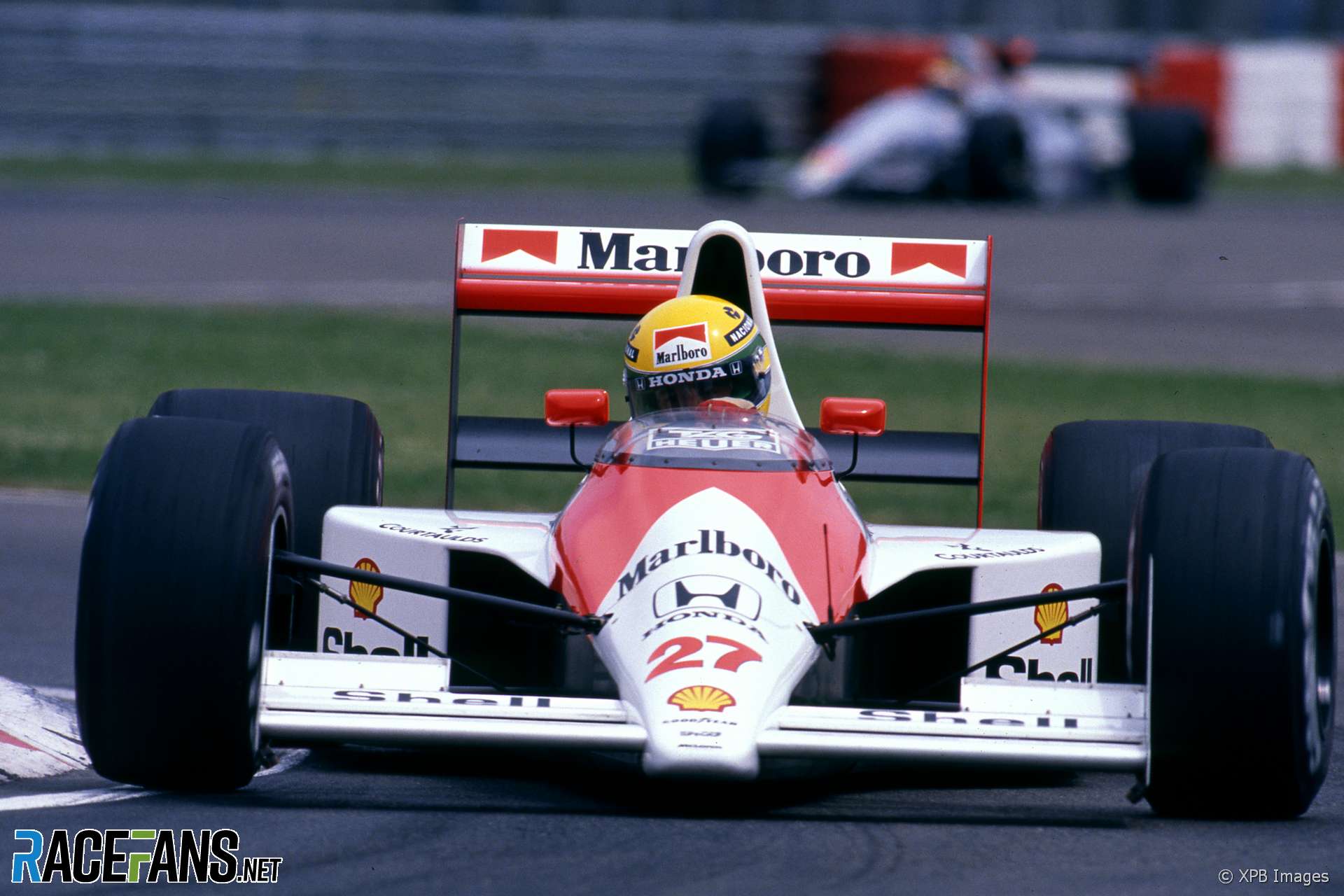
Ayrton Senna won the season-opener for the latter in Phoenix after duelling spectacularly with Jean Alesi’s Tyrrell. He was on course to follow it up with victory at home in Interlagos, the first time he had raced in his home city in F1, until he tangled with Alesi’s team mate Satoru Nakajima while lapping him. Senna’s arch-rival Alain Prost capitalised, winning for Ferrari.
Advert | Become a RaceFans supporter and
Prost had seven long weeks to savour his victory – and Senna just as long to stew over the circumstances of his defeat – before the series reconvened at Imola for round three. Then as now, no races took place at all that April. However in 1990 that was simply how the season had been scheduled.
Even that seven-week break is dwarfed by the longest gaps between consecutive rounds earlier in the history of the world championship. In the fifties and sixties the season frequently opened in January then resumed several months later.
The longest such gap occured in 1965. Jim Clark won the season-opener at the East London circuit in South Africa on New Year’s Day. The next round took place almost five months later: Graham Hill won the Monaco Grand Prix on May 30th.
So if it feels like today’s 35-day wait drags, F1 fans in 1965 had to wait 149 days between those first two races. However there were four non-championship races for F1 cars during that time, plus the seven-round Tasman series contested by many F1 drivers in top single-seater cars.
Gaps between F1 seasons have been much longer than this. The greatest of these occured after the inaugural 1950 season, after which the second began 266 days later. For a recent comparison, the delay to the start of the 2020 season due to the Covid-19 pandemic resulted in a 217-day gap between rounds, which was the third-longest of all time.
Although the situation in the Middle East remains dire, its effect upon F1 does not yet look likely to rival the pandemic. But the full economic impact of the war remains to be seen.
Miss nothing from RaceFans
Get a daily email with all our latest stories – and nothing else. No marketing, no ads. Sign up here:
Advert | Become a RaceFans supporter and
F1 history
- Did Norris actually win Formula 1’s closest championship fight of all time?
- Hamilton is Ferrari’s first new driver in 44 years to complete season without a podium
- Ferrari are on course to lose an F1 record they’ve held since 2004
- Red Bull in 2010 or Ferrari in 1979? Past title fights illustrate McLaren’s current dilemma
- Verstappen hasn’t missed a title-winning chance yet. Which champion last did this?
Published by

Keith Collantine
Lifelong motor sport fan Keith set up RaceFans in 2005 – when it was originally called F1 Fanatic. Having previously worked as a motoring journalist, Keith began running the site full-time in 2010, achieving a long-held ambition to dedicate his full attention to his passion for motor racing. View all posts by Keith Collantine
