

 Autobayng News Team

Jihadist violence rose sharply in Nigeria and Democratic Republic of Congo last year, even as global deaths from terrorism dropped to their lowest level in a decade, according to a new report.
Nigeria recorded the largest increase in terrorism deaths globally in 2025, with fatalities rising by 46% from 513 in 2024 to 750, placing it fourth in the Global Terrorism Index, behind Pakistan, Burkina Faso and Niger.
Africa’s most populous nation is grappling with a multifaceted security crisis as extremist groups such as Boko Haram and its offshoots attempt to carve out control of swathes of territory. Various ethnic militia and other criminal elements, including “bandit” groups, are also active, mostly in north and central Nigeria. Newer threats like terrorists from the Lakurawa group are also emerging.


In February, 162 people were massacred in Kwara state near the border with the Benin Republic, one of the deadliest single attacks in the country’s recent history.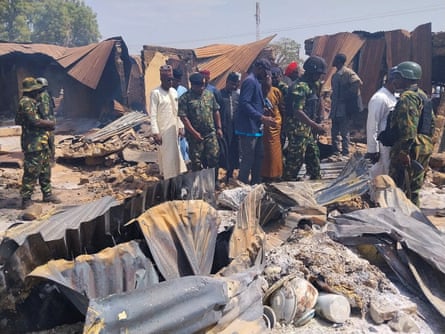
On Wednesday the army said troops backed by air support had repelled a coordinated assault by Islamist insurgents on a military base in the north-eastern state of Borno, killing at least 80 fighters including senior commanders. The assault comes after multiple suicide bombings on Monday in Maiduguri, the capital of Borno, that killed at least 23 and left more than 100 wounded.
In the DRC, terrorism-related deaths rose by nearly 28% in 2025, increasing from 365 to 467 and pushing the central African state to eighth place on the index, its worst ranking. The rise was primarily driven by the IS-affiliated Allied Democratic Forces (ADF).
The rise in Nigeria and the DRC contrasts with the rest of the world. The index, produced by the Australian thinktank Institute for Economics & Peace (IEP), recorded a global decline in deaths of 28% to 5,582, while total attacks fell by nearly 22%.
There was a 280% increase in deaths from terrorism in the west, with 57 deaths recorded in 2025. Twenty-eight people died in the US from terrorist attacks, the highest figure in the country since 2019. The rise, the index reveals, is increasingly driven by youth radicalisation and lone-wolf actors.
“Viewed in totality, these trends point to one sobering conclusion: a fracturing world order risks erasing the hard-fought gains made against terrorism over the past decade,” said Steve Killelea, IEP’s founder.
More than half of all deaths from terrorism worldwide in 2025 occurred in the Sahel, seen as the centre of global terrorism, despite a drop from the previous year. Burkina Faso, where the junta only controls about a third of the territory, recorded the largest decrease in terrorism deaths worldwide, with fatalities dropping by half in 2025. Civilian casualties fell by 84%.
Experts said the change suggests the al-Qaida affiliate Jamaat Nusrat al-Islam wal Muslimeen (JNIM) is deliberately reducing attacks on civilians to win “hearts and minds” and consolidate its territorial gains with increasing sophistication.
Killelea said: “For JNIM, the change in tactics can perhaps best be explained by the ‘value v vulnerability’ trade-off. Military forces and political figures are considered high-value targets. As JNIM now controls more territory, it is better able to carry out attacks on higher value targets.”
The tactical shift fits into a pattern of jihadists launching coordinated and sophisticated assaults on military bases across the region, as counterinsurgency missions ramp up. JNIM, which launches drones frequently, has used them in more than 100 cases of drone violence in the last three years across the Sahel. According to the Armed Conflict Location & Event Data (ACLED), there have also been 16 drone incidents involving the Islamic State West Africa Province (ISWAP) since 2014.
“Ten [of the ISWAP incidents] involved drone attacks and the remainder were intelligence‑gathering or surveillance missions used to prepare ground offensives against military targets,” said Ladd Serwat, ACLED’s senior analyst for Africa.
The report also reveals a growing concentration of attacks in border regions, including the Central Sahel tri-border area, and the Lake Chad Basin.
