Autobayng News Team

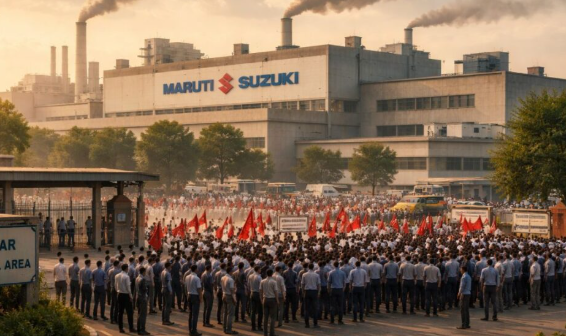
While the move offers relief to workers, it is expected to increase cost pressures for automakers such as Maruti Suzuki, already grappling with supply disruptions and higher input prices.
“>
India’s auto-making state of Haryana ordered a 35 per cent hike in minimum wages on Friday, after factory workers boycotted work and staged protests this week over rising living costs as a result of the US-Israeli war on Iran.
Haryana’s government said it was raising the minimum wage for unskilled workers to $165 per month, from roughly $120, effective April 1, a move that helps workers but will raise cost pressures for India’s auto industry at a time of rising input prices and supply chain disruptions.
The decision comes a day after clashes between the police and workers in Manesar, located 30 miles (48.28 km) south of New Delhi and home to companies like Maruti Suzuki, as well as hundreds of ancillary units that feed into it.
“We urge the workers to … peacefully carry on their work,” Ajay Kumar, a state official, said in a video address on Friday.
Factory workers have been hit hard as prices at eateries have surged due to disrupted supplies of gas in recent weeks, prompting some to return to their villages.
India is the world’s second-largest liquefied petroleum gas (LPG) importer and is battling its worst gas crisis in decades, with the government cutting supplies for industries to shield households from any shortage of cooking gas.
The government’s move will increase costs for India’s car industry, already dealing with higher raw material prices stemming from the Iran war. While the likes of Tata Motors and Mahindra have raised car prices, Maruti has warned of a similar move.
Heavy reliance on gas
India’s heavy reliance on gas across the economy – businesses of all sizes, households, agriculture, public transport – makes its factories as well as lower-income earners among the most vulnerable in Asia.
Akash Kumar, 25, who works at Munjal Showa, a supplier to motorbike maker Hero MotoCorp, said street vendors were charging him double the price for a meal of bread, curry and yogurt.
Friday’s decision, he said, will bring some relief. “Whatever we get, we have to be happy,” he said, adding that workers have resumed duties after being told about the pay hike.
Industrial unrest in Manesar affected various auto suppliers this week, according to Reuters’ interviews with more than 30 workers. Workers said they were demanding pay rises to sustain their livelihoods as food was becoming expensive and gas supplies were erratic.
The federal government maintains there is no shortage of cooking gas for households and it is increasing availability of smaller cylinders for daily-wage earners and migrants.
Munjal Showa told Reuters its production was partially impacted this week.
At Roop Polymers, a supplier to Maruti and Honda, notices on the factory-gate wall warned of disciplinary action against absent workers, and a company executive said “work was heavily disrupted inside” due to the protests.
Roop, Maruti, Honda and Hero did not respond to requests for comment.
While talks between Iran and the US have raised hopes of de-escalation, auto industry executives said supply chains could take weeks to normalise, as a growing number of migrant workers head back home.
India has about 400 million local migrant workers heading to places such as Manesar to earn a minimum wage for an average 48 hours a week.
“Most employers are trying hard to hold on to the workforce that is running back by offering two meals a day or paying a small bonus,” said Vinod Kumar, president of India SME Forum which represents thousands of small and medium-sized businesses.
The group is seeking government help to implement “emergency” measures and establish cluster-based common kitchens, as Kumar said “once labour leaves, it is very difficult to get them back.
- Published On Apr 11, 2026 at 10:13 AM IST
Join the community of 2M+ industry professionals.
Subscribe to Newsletter to get latest insights & analysis in your inbox.
All about ETAuto industry right on your smartphone!
- Download the ETAuto App and get the Realtime updates and Save your favourite articles.