Autobayng News Team


 In PV landscape, FY26 has truly been a year of significant developments. We have achieved record volumes in PVs and are likely to close at around 4.5 million units in wholesales, which would be the highest-ever recorded in India.
“>
For the Indian auto industry, FY26 resembled a high-stakes T20 match, where the first half was slow, but the second half saw aggressive scoring. After a period of sluggish sentiment, the sector capitalised on GST rate cuts from 28 per cent to 18 per cent and a resurgence in rural demand on the back of a good monsoon, to overcome early volatility and achieve record-breaking annual performance.In this special Year-in-Review discussion, ETAuto engaged with Rakesh Srivastava, industry veteran and Ashim Sharma, Senior Partner & Business Unit Head, Nomura Research Institute, to decode the auto industry’s segment-wise dynamics that emerged during the year. Amidst looking geopolitical uncertainties, the experts also offer their broader outlook for FY27. Read on to get a pulse of the industry. Edited excerpts:
What is your view on the overall industry performance in FY26?
Rakesh Srivastava: In the passenger vehicle (PV) landscape, FY26 has truly been a year of significant developments. We have achieved record volumes in PVs and are likely to close at around 4.5 million units in wholesales, which would be the highest-ever recorded in India. Moreover, growth has been broad-based. Passenger cars, including hatchbacks and sedans, grew modestly at around 1.3 percent. Utility vehicles, which now form the backbone of the market, grew at approximately 8.9 percent. Even the van segment saw a positive movement of about 3.7 percent. So this is not a one-segment-driven story, but rather a situation where almost every category has contributed to the overall growth.The industry entered FY26 after a relatively muted FY25, which saw growth of only about 2.6 per cent. Added to that were geopolitical concerns, particularly tariff wars. These factors created an environment of uncertainty, which impacted consumer sentiment in the first half of the year.The turnaround came in the second half, wherein GST rationalisation played a critical role in boosting demand. From October onwards, the industry saw strong double-digit growth in several months.If we look at the broader auto industry, including PVs, two-wheelers, and three-wheelers, total volumes are expected to touch around 27 million units. This would again be one of the highest- ever levels.
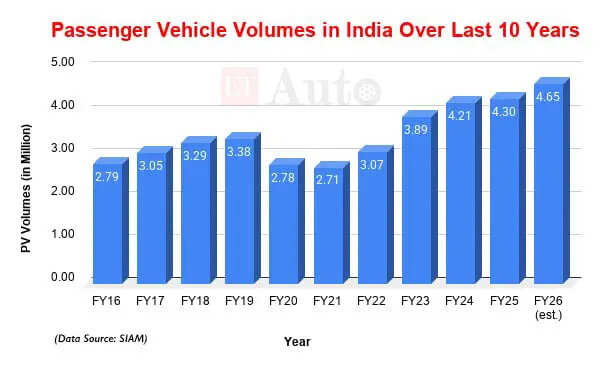 Despite a brief post-pandemic dip in 2020, PV sales have risen steadily in India over the last decade to achieve their highest wholesale volumes in FY26.
“>
How significant was the GST boost and what other factors supported growth?
Ashim Sharma: GST rationalisation was undoubtedly one of the most important triggers for the growth in FY26. However, it worked alongside several other supportive factors.Revision in income tax slabs was one of the early enablers, which effectively increased disposable income for consumers, particularly for middle-income households.
Timing of the GST reduction was important too as it coincided with the festive season, which is traditionally a high-demand period for the auto industry.
We also had a good monsoon, which supported rural incomes and demand. Additionally, there was an element of pent-up demand due to anticipation of a GST cut.
From an OEM-wise perspective, which carmakers were the biggest gainers in FY26?
Rakesh Srivastava: The biggest gainers were those who correctly anticipated the shift in consumer preferences and aligned their product portfolios accordingly.Maruti Suzuki continues to remain the market leader and has maintained its dominance. Kia, Mahindra and Mahindra, and Tata Motors have emerged as strong performers. These companies have successfully tapped into the growing demand for utility vehicles and SUVs.
We have also seen smaller gains from players like Skoda and Stellantis brands, along with Toyota, which continues to strengthen its position through a focused product strategy.
The most surprising development has been the performance of Hyundai. For nearly 28 years since its entry into India, Hyundai held the number two position in the PV market. However, in FY26, it slipped to the third position, with Mahindra overtaking it. Hyundai is also the only player among the top six OEMs to have seen a decline in volumes compared to the previous year.
Another structural trend is the increasing consolidation in the market. The top six players, namely Maruti, Hyundai, Tata, Mahindra, Kia, and Toyota, are collectively increasing their share of total volumes. The remaining players, which are about 10 in number, are collectively operating in a very small share of around 6 per cent. This creates sustainability challenges for smaller OEMs.
Looking ahead, the competition for the third position is expected to intensify. Tata Motors is in a strong position to challenge Hyundai.
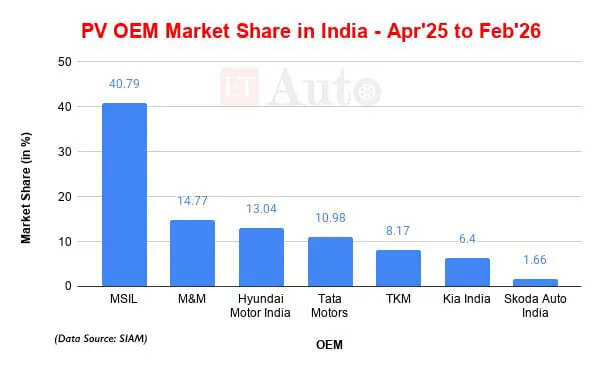 Maruti Suzuki still leads the market with over 40% market share, but FY26 belongs to Mahindra & Mahindra—now officially the No. 2 OEM after overtaking Hyundai
“>
How did EV penetration play out in FY26, both in mass-market and luxury-car segments?
Ashim Sharma: EV penetration in India currently stands at around 4.5 per cent, and we expect it to increase by another 2 to 2.5 percentage points in the near term. Globally, it has been observed that once markets reach the 5 per cent threshold, adoption begins to accelerate more rapidly, and India appears to be approaching that point.
One of the key drivers for future growth will be the entry of large OEMs such as Maruti Suzuki into the EV segment. Their extensive distribution network across the country will help improve accessibility and awareness.
However, EV adoption is not uniform across the country. It is concentrated in specific urban pockets where charging infrastructure is relatively more developed. Even if overall electricity supply is adequate, infrastructure at the local level, such as transformers and feeders, needs to keep pace with demand.
In terms of segmentation, EV penetration is significantly higher in the luxury segment versus the mass market. Luxury buyers are less sensitive to price, and they are more willing to adopt new technologies. Also, The models available in the luxury EV segment are often globally aligned and not decontented, which enhances their appeal.
In contrast, mass-market customers are more price-sensitive and tend to compare EVs directly with ICE vehicles. Issues like range anxiety, charging time, and resale value also play a role in slowing adoption in this segment.
The two-wheeler industry is set to bounce back to over 21 million units in FY26. How do you see the segment’s performance and what were the key enablers to this growth?
Ashim Sharma: The two-wheeler segment has shown a strong recovery, returning close to pre-COVID levels. Several factors have contributed to this growth.
Regulatory changes such as ABS norms did not significantly impact the entry-level segment, which helped maintain affordability. Income tax benefits and GST reductions further improved purchasing power.
Premiumisation is another important trend, particularly in the 350cc segment, which has seen strong growth. New entrants like Harley-Davidson and Triumph have expanded offerings in this space.
Rural demand has been a major driver, supported by a good monsoon. Additionally, urbanisation and limited public transport infrastructure continue to drive demand for personal mobility.
Rakesh Srivastava: The industry is expected to grow at around 10 per cent. Scooters have been the standout performers, with growth of about 17 per cent, driven largely by EV adoption and urban mobility needs.
Motorcycles remain the largest segment, growing at around 6 per cent. Overall, the 2W industry is in a strong recovery phase, supported by both structural and cyclical factors.
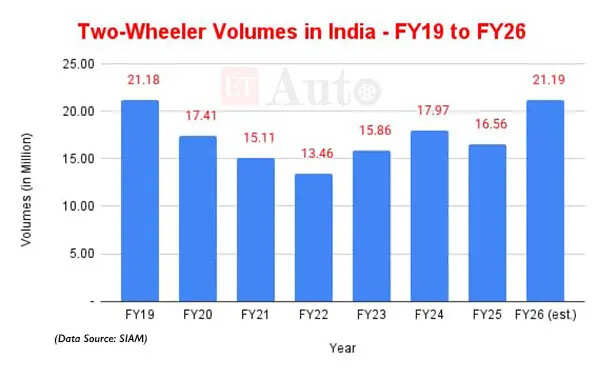 After a prolonged five-year slump, the two-wheeler industry is finally roaring back in FY26 with GST reduction acting as the key growth architect.
“>
Which OEMs were the biggest gainers and losers in the 2W segment last year?
Rakesh Srivastava: TVS has emerged as one of the biggest gainers, particularly in the EV space. Hero MotoCorp and Honda have also performed well and strengthened their positions.
Bajaj has maintained stable domestic volumes but exports remain its key growth driver.
Among newer players, Ather has shown strong growth and is gaining traction in the electric scooter segment. However, Ola Electric has seen a sharp decline in volumes, nearly 50 per cent, primarily due to concerns related to product quality and after-sales service.
How did the commercial vehicle and three-wheeler segment perform in FY26?
Ashim Sharma: The commercial vehicle segment grew by around 10 per cent, driven largely by demand for light commercial vehicles in the e-commerce and logistics sectors. Infrastructure development and mining activities supported growth in medium and heavy commercial vehicles.
Fleet replacement cycles also contributed, as many vehicles are reaching the end of their lifecycle. The bus segment is seeing renewed momentum due to electrification initiatives and government support.
Three-wheelers also grew at around 10 per cent, with electrification playing a key role. This segment has emerged as a leader in EV adoption, particularly in cargo and passenger applications.
Rakesh Srivastava: Three-wheeler volumes are expected to reach around 9 lakh units, with growth of about 12 per cent. Passenger three-wheelers grew strongly due to last-mile connectivity needs, while cargo three-wheelers benefited from e-commerce demand.
How did India Auto Inc fare in exports performance in FY26? What are the opportunities ahead?
Rakesh Srivastava: India has emerged as a strong export hub for automobiles. PV exports are around 9 lakh units, while 2W exports are approximately 51 lakh units, growing at a strong pace.
Three-wheeler exports are also performing well. India’s strengths lie in cost competitiveness, quality manufacturing, and a strong supply chain ecosystem.
Ashim Sharma: Looking ahead, EV exports present a significant opportunity. Many global markets are facing challenges related to fuel availability and pricing, which creates an opening for EVs.
Indian OEMs can leverage their expertise and cost advantage to expand into these markets, particularly in two-wheelers and three-wheelers.
What is your growth outlook for H1 FY27? What are the immediate risks the industry is looking at?
Rakesh Srivastava: I remain optimistic about the growth outlook. Passenger vehicles could grow at around 6 per cent. The fundamentals of the industry remain strong, and penetration levels are still relatively low.
However, there are risks. Supply chain disruptions, geopolitical tensions, and logistics challenges could impact growth.
Ashim Sharma: The situation remains dynamic. Rising fuel prices, inflation, and potential interest rate hikes could act as headwinds. However, the industry’s ability to adapt and respond quickly will be critical in navigating these challenges
Join the community of 2M+ industry professionals.
Subscribe to Newsletter to get latest insights & analysis in your inbox.
All about ETAuto industry right on your smartphone!
- Download the ETAuto App and get the Realtime updates and Save your favourite articles.