

 Autobayng News Team


The FIA has issued the first details of how Formula 1 teams’ power unit use will be restricted at the opening round of the new season.


Due to the complexity of F1’s new power units for 2026, different restrictions will be enforced at each track. This is partly due to the variation in energy harvesting opportunities at different circuits and the need to ensure “the maximum speed of the F1 car remains compatible with the design and construction of the relevant circuit,” according to the regulations.
The restrictions include the maximum amount of energy which may be recharged per lap. Two different levels apply during a race: a lower level during normal running and a higher limit when a driver is close enough to a rival to be able to use Overtake. Different levels will also apply between sessions.
The peak 8.5MJ recharge will be permitted when a car is in Overtake mode during a race. This limit may also be reached at all times in free practice sessions and when a car is on an out-lap in any session other than a race. In normal conditions during a race the limit falls to 8MJ, while a 7MJ limit applies during qualifying.
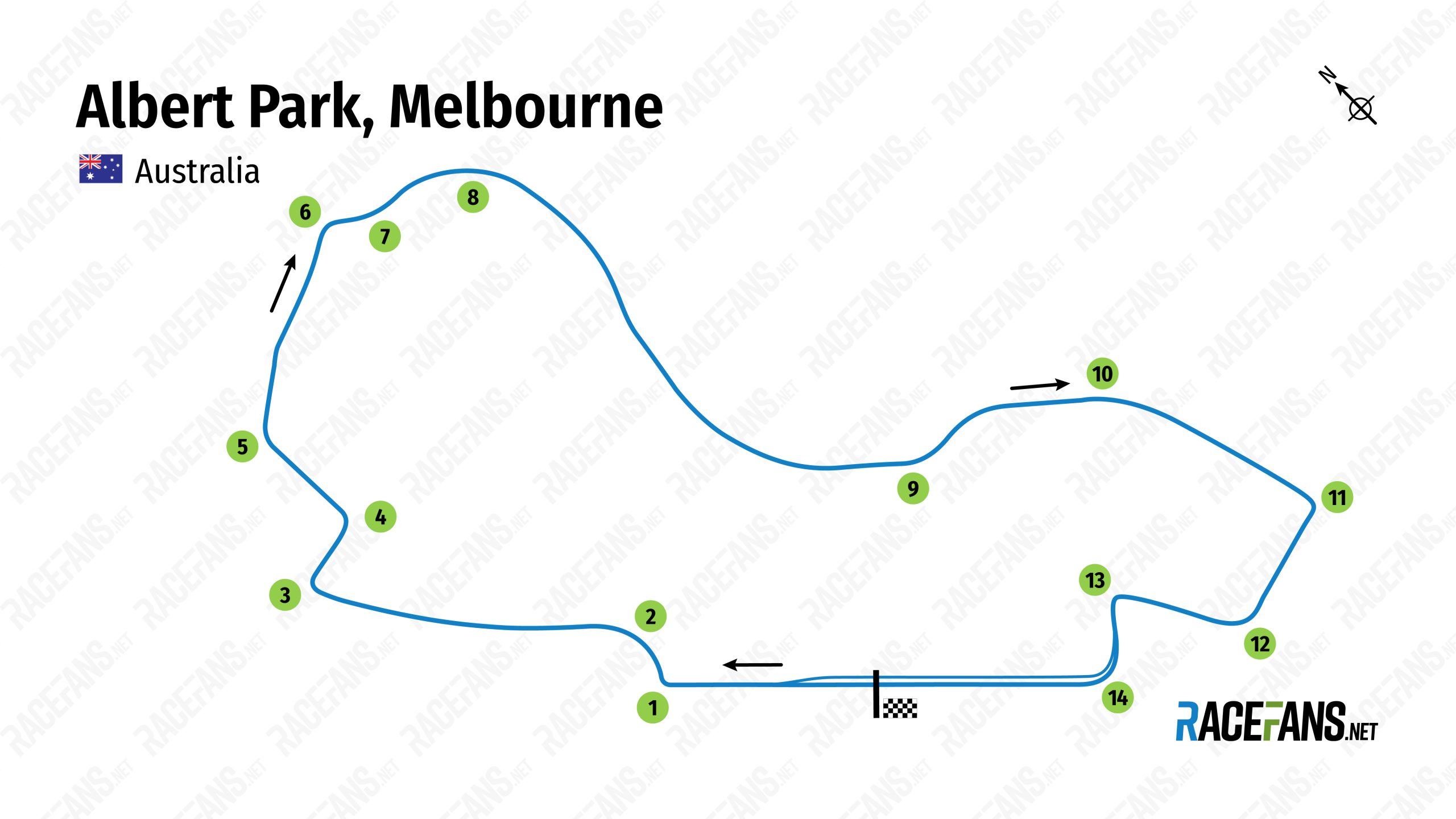
The rate at which teams may reduce the power from their engine is also governed by the rules. The maximum power reduction rate is linked to the proportion of the track the FIA defines as being ‘power limited’.
Where more than 3.5 kilometres of a track is considered ‘power limited’, the rate of reduction is capped at 50kW in any one-second period. The 5.278km Melbourne track narrowly meets this limit, as the FIA has deemed its power limited distance to be 3.518km.
Exceptions to the power reduction limitation apply at two points on the lap. The power reduction may be increased from 150kW to 350kW in a defined ‘power limited pending’ period, when the car is between turns 11 and 13 – strictly defined as falling between the 4.1km and 4.55km points on the lap. The MGU-K power reduction may be reset at the exit of turn five (1.45km to 1.6km into the lap).
Advert | Become a RaceFans supporter and
The FIA has also defined how Overtake mode, its power-based replacement for DRS, will work. As was the case with DRS, drivers will be allowed to use Overtake when within a second of another car, though the FIA has the capability to adjust this if needed.
The detection line is positioned at the exit of turn 13 and drivers may deploy the boost from the entry to turn 14. In Overtake mode, drivers will be allowed to consume more power between 290kph and 355kph.
Miss nothing from RaceFans
Get a daily email with all our latest stories – and nothing else. No marketing, no ads. Sign up here:
Advert | Become a RaceFans supporter and
2026 Australian Grand Prix
- Bottas’s grid penalty for Australian Grand Prix cancelled by rule change
- FIA confirms Overtake mode details and power unit restrictions and for Melbourne
- Hamilton concerned F1 fans won’t understand why racing looks so different in 2026
- FIA confirms ‘straight mode’ zones for Melbourne and no pit lane speed limit change
- F1 suspends curfew rules for Australian GP due to travel disruption
Published by

Keith Collantine
Lifelong motor sport fan Keith set up RaceFans in 2005 – when it was originally called F1 Fanatic. Having previously worked as a motoring journalist, Keith began running the site full-time in 2010, achieving a long-held ambition to dedicate his full attention to his passion for motor racing. View all posts by Keith Collantine
