

 Autobayng News Team

- A new study shows how zero-emissions cars can clean up the air in dense urban areas.
- Researchers used satellite data to see how much nitrogen dioxide was in California’s air between 2019 and 2023.
- As the number of electric cars and plug-in hybrids rose, neighbourhoods had lower NO₂ concentrations.
Everybody knows that electric cars don’t emit carbon emissions because they don’t burn any fuel. And while there are some studies out there that show how zero-emission cars can improve the quality of air in urban areas, they weren’t always definitive.
Now, though, a new study from the University of Southern California’s Keck School of Medicine used satellite data to confirm that zero-emission cars do have a clear and positive impact on air quality. Research shows that for every 200 zero-emissions vehicles added to a neighborhood, NO₂ levels drop by 1.1%. The more ZEVs, the lower the NO₂ concentration.


Published in The Lancet Planetary Health, the new study pulled high-resolution satellite data from the Tropospheric Monitoring Instrument (TROPOMI) that can detect nitrogen dioxide (NO₂) in the atmosphere by measuring how the gas absorbs and reflects sunlight, according to Phys.org. This data was then used to calculate the annual average NO₂ levels in each California neighborhood from 2019 to 2023.
At the same time, publicly available data from the state’s Department of Motor Vehicles was thrown into the mix, specifically the number of zero-emission vehicles that were registered in each neighborhood. As a reminder, ZEVs include electric cars, plug-in hybrids and fuel-cell cars.
Nitrogen dioxide (NO₂) is released when fossil fuels are burned, and it can trigger asthma attacks, cause bronchitis and increase the risk of heart disease and stroke. In other words, it’s very bad.
So, what did all this data show? For every 200 new zero-emissions vehicles registered in a California neighborhood between 2019 and 2023, NO₂ levels dropped by 1.1%. According to the study’s authors, a typical neighborhood added 272 ZEVs, with most neighborhoods gaining between 18 and 839 ZEVs. Over the study period, the ZEV market share increased from 2% to 5% of all light-duty vehicles across California.
“These findings show that cleaner air isn’t just a theory–it’s already happening in communities across California,” said Sandrah Eckel, Ph.D., associate professor of population and public health sciences at the Keck School of Medicine, and the study’s lead author. “We’re not even fully there in terms of electrifying, but our research shows that California’s transition to electric vehicles is already making measurable differences in the air we breathe,” she added. Left: Annual NO2 as measured in the atmosphere by TROPOMI. Right: Annual NO2 as measured at ground level by US EPA monitors. Photo by: InsideEVs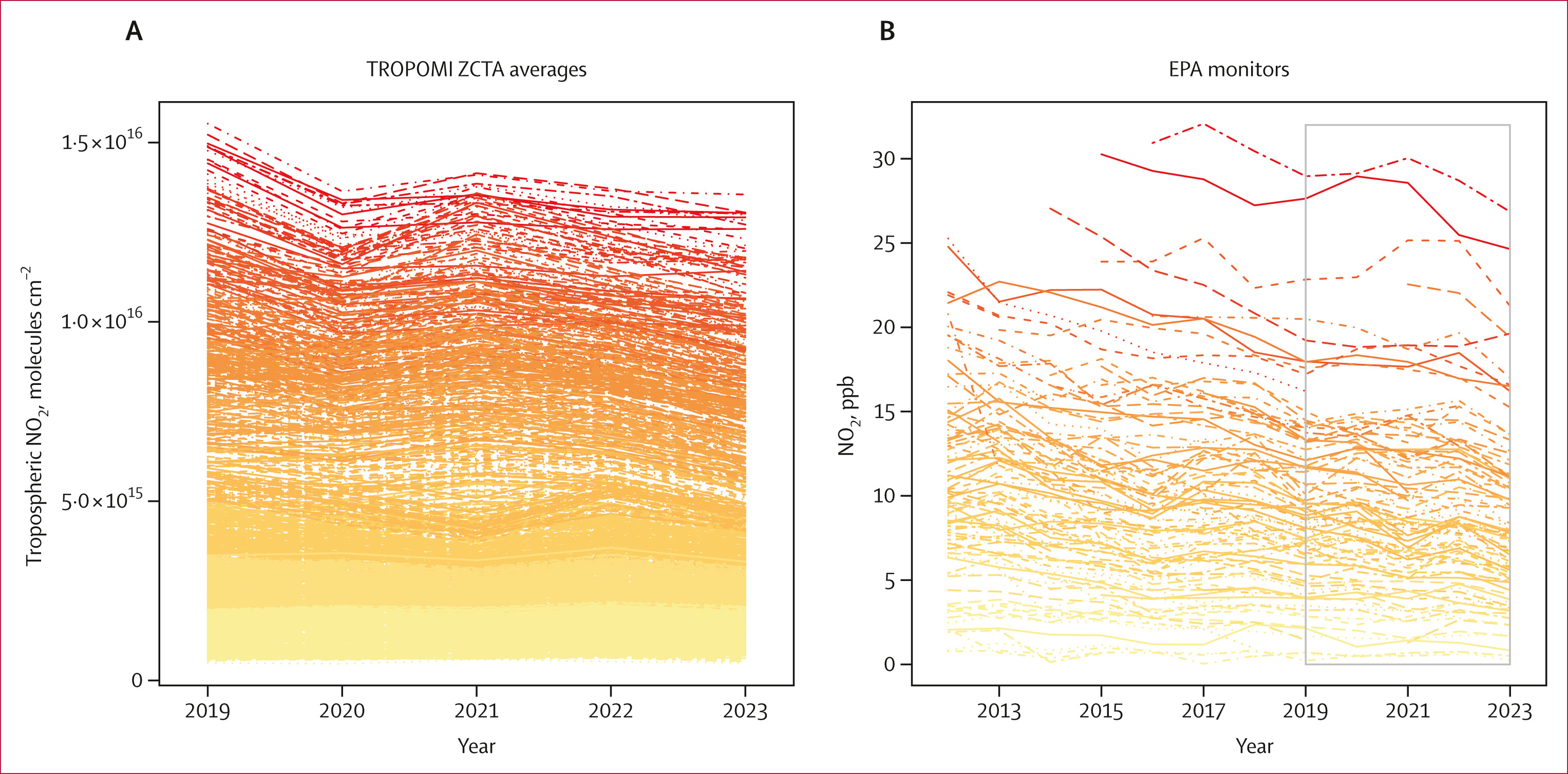

To make sure that the results were reliable, the researchers took extra precautions, like excluding the year 2020 entirely to account for the pandemic-related changes as a contributor to NO₂ decline. They also confirmed that neighborhoods that added more gas-powered cars saw a rise in pollution. Finally, the results from the satellite data was relicated using updated data from ground-level monitors from 2012 to 2023.
“We tested our analysis in many different ways, and the results consistently support our main finding,” said Erika Garcia, Ph.D., MPH, assistant professor of population and public health sciences at the Keck School of Medicine and the study’s senior author.
This is great news for anybody living in crowded urban areas where the nasty gases that come out of cars’ tailpipes linger at ground level and ultimately make their way into people’s lungs. And as more EVs and plug-in hybrids hit the road, they should help clean up the air in your city, too—as proven by science. More Stuff Like This We want your opinion! What would you like to see on Insideevs.com? – The InsideEVs team
