Autobayng News Team

- Published On Feb 10, 2026 at 04:44 PM IST
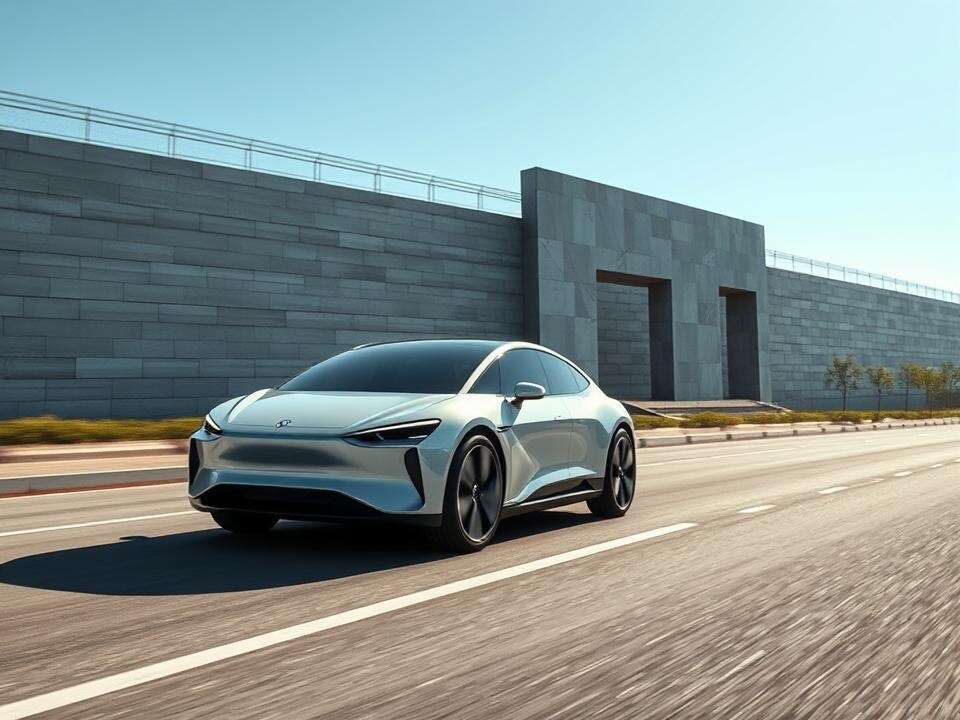 Despite US tariffs and software bans, Chinese automakers are signaling potential entry into the American market.
“>
In a world being conquered by China’s auto companies, one redoubt stands out: The US. It deters Chinese companies with sky-high tariffs and a ban on auto software systems developed or controlled by them. It is also the biggest auto market in the world by revenue and one of the most profitable — China’s auto giants would love to find a way in.Lately, there’s been a drip-drip of signals that they just might.
Speaking last month in Detroit, of all places, implacable Sinophobe President Donald Trump said that if Chinese automakers wanted to build plants in the US, he would “love that.” A recent report in the Financial Times that Ford Motor Co. had held talks on collaborating with Xiaomi Corp., among others, on electric vehicles drew a denial from the company.
Ford’s Chief Executive Jim Farley is, however, an outspoken fan of Xiaomi’s EVs, and generally talks of China’s auto sector with awe; the biblical kind that comes with a dose of dread. The company is reportedly talking with another Chinese rival, Zhejiang Geely Holding Group Co., about sharing factory capacity in Europe.
Meanwhile, mirroring Trump’s love-hate approach, Mike Stanton, who heads the National Automobile Dealers Association, told a conference crowd in Las Vegas last week that while 95 per cent of his organization backs federal policies blocking imports of Chinese vehicles, “we’re not telling dealers not to take the Chinese franchises.”
China’s automakers are taking the world by storm. Exports have surged nearly eightfold over the past five years, leapfrogging former number one Japan. Michael Dunne, a former auto executive turned consultant at Dunne Insights, tells me that in some international markets, companies are buying two Chinese pickups like SAIC Motor Corp. Ltd.’s Maxus for almost the same price as one Ford Ranger or Toyota Tacoma, letting them “run one out, then bring in the other one.”Despite the public rhetoric, there is a quietly spoken view across and around the industry that Chinese vehicles can’t be kept out of fortress America forever. The analogy is strengthened by the forces gathering around the walls: Mexico has emerged as the number one destination for Chinese auto exports, and Canada has just agreed a quota as part of its effort to hedge against an unfriendly Washington. US auto companies could use the expertise and supply-chains Chinese companies have built in electric and hybrid powertrains.US drivers, meanwhile, could use some cheaper but high-quality models in a market where new vehicles are increasingly the preserve of high earners. Cheaper vehicles might also spur elusive sales growth, which is why dealers are more ambiguous about China.
Speaking to me from that conference in Vegas, Dunne said: “Dealers here are asking me: Who’s the next Toyota? Who’s the next Hyundai? We want to sign them up.”
In one sense, it’s actually those Japanese and Korean brands that have the most to fear from Chinese entry to the US. Initially, anyway.
That entry would have to be in the form taken by the likes of Toyota Motor Corp. decades ago; that is, not imports but instead building auto plants in the US. This could be done via US majority-owned joint ventures, reversing the model China adopted itself starting in the 1990s (and as I argued here). As for the ban on Chinese software, operating systems could be licensed from any number of US developers, from Ford to Waymo LLC.
Plus, Chinese entrants could be limited to entry-level models, at least initially. That would mitigate the threat to Detroit and its unionized workers because the US automakers have largely abandoned that segment. I sampled 189 models or series from the top 10 automakers in the US by unit sales (excluding Tesla Inc. due to lack of disclosure).
Using average transaction prices and sales for 2025, one can calculate the implied revenue for each model and then calculate roughly how much of each company’s revenue pool relates to lower-priced models, using $40,000 as a threshold.
It is immediately clear that the more affordable end of the US vehicle market is owned disproportionately by the Asian transplants. Meanwhile, Detroit’s big earners — Ford’s F-series, General Motors Co.’s Chevrolet Silverado and GMC Sierra, and Stellantis NV’s Ram pickups — sit north of $60,000.
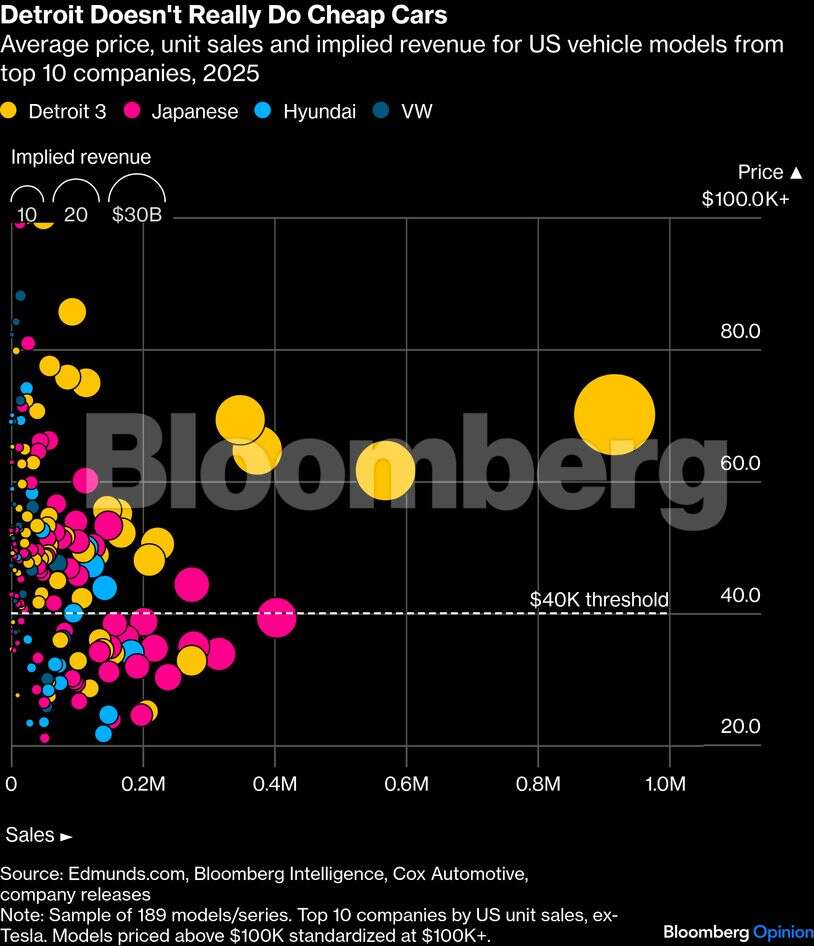
Based on this sample, the smaller Japanese auto companies and Korea’s Hyundai look relatively more exposed in a scenario where Chinese entrants targeted the lower end of the US market. These numbers aren’t exact given lack of data for some models, but the gap between the top and bottom end in terms of exposure is stark enough.
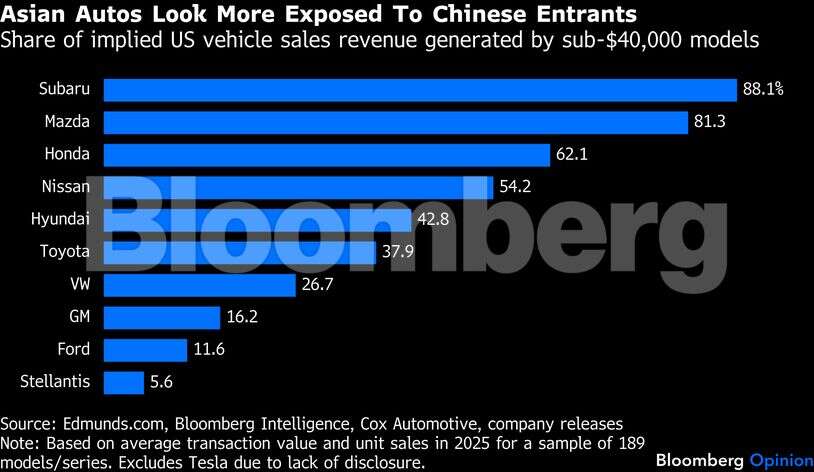
In a sense, this gives the Detroit automakers, and their dealers, a route to shaping any deal allowing Chinese entry that gives the latter free rein in cheaper models in exchange for helping the US firms advance their capabilities in EVs.
Some nuance is in order, however. One reason the Asian automakers have captured the cheaper end of the market is that they have lower breakeven costs and find it easier than the Detroit 3 to make money there. Chinese entrants would impose competitive pressure, for sure. But Toyota, especially, brings its own competitive edge, honed over decades (including when they were also breaking into the US).
Conversely, while Stellantis looks particularly well-placed at the bottom of that bar chart above, that belies its bigger challenges. As much as Friday’s selloff in that stock was sparked by a massive write-down linked to whiplash in US EV policy, Stellantis’ more chronic issue concerns rebuilding its market share in the US and simultaneously dealing with surging Chinese competition across a range of international markets.
Moreover, Detroit’s truck-sized moat is tough to grow and also not indefinite.
While Chinese entry could be confined to the lower end of the market to begin with, all automakers seek to use those cheaper models to capture customers that trade up to premium vehicles over time. As much as that inevitability would warrant Detroit digging in its heels against a deal to bring in Chinese automakers, they must consider the wider context.
Given the leaps made by Chinese automakers, acknowledged plainly by Farley but also implied by partnerships like Stellantis’ with Zhejiang Leapmotor Technology Co. Ltd., it seems inconceivable that such desirable, and cheaper, products will simply be kept out of American drivers’ hands forever. Someone cutting a deal, especially one that directs the upfront pain elsewhere, looks ever more probable.
- Published On Feb 10, 2026 at 04:44 PM IST
Join the community of 2M+ industry professionals.
Subscribe to Newsletter to get latest insights & analysis in your inbox.
All about ETAuto industry right on your smartphone!
- Download the ETAuto App and get the Realtime updates and Save your favourite articles.