

 Autobayng News Team

In November 2022, I sat across from Honda’s CEO, Toshihiro Mibe. New on the scene and eager to own the future, the CEO talked a big game about Honda’s commitment to carbon neutrality and electrification. The linchpin of this transformation, he said, would be the company’s partnership with General Motors. In his words, this wasn’t a just a badge-job plan to build the Honda Prologue; it was a multi-year partnership between “equals” to develop affordable EVs and conquer tomorrow’s auto market.
Three and a half years later, that joint affordable EV plan is a distant blip, another failed launch from a company that still hasn’t built a modern, long-range EV itself, let alone an affordable one. When the plan changed in 2024, again, it this time hinged around the 0 Series, a new software-defined vehicle family planned to encompass three U.S.-built models by the end of 2026.
Now those are all dead.


Gallery: Honda 0 Series sedan and SUV prototypes teasers (2024)
The company is performing the only tactical maneuver it’s mastered in the EV era: retreat.
In the press release for this announcement, the company declares its continued commitment to carbon neutrality and electrification. That’s what executives there have been telling me for five years, and I’ve run out of patience. If the company cares about carbon neutrality, it needs to prove it, not just say it. And if it wants any hope of being a real contender in the next era of the automobile, it had better start competing, rather than waiting on the sidelines for competitors to figure things out. By the time they do, it’ll be too late for Honda to catch up.
A Long, Embarrassing History
Honda has produced only a few EVs on its own. But the playbook is set, and impressively consistent: Launch a low-volume EV with uncompetitive range, even for its era, sell it in as few markets as possible, and then cancel it when it inevitably fails. Imply to investors that this is why hybrids are the only possible answer.
The Clarity Electric and Fit EV both followed this course, both offering around 80 miles of range, and both only sold in markets like California and Oregon to satisfy a legal requirement for zero-emissions vehicles. The Honda e, the company’s cutest EV by far, had a longer run in Europe, but still only about three years before dying due to low sales. The Acura ZDX may not have even been a Honda—a GM product underneath, built by GM at a GM factory—but it died after less than two years on sale, to make room for the 0-Series-based RSX which was due to replace it. That product beat the ZDX’s record, dying before it even went on sale. The only Honda group EV left on sale in the U.S. is the Prologue, a reskinned Chevy Blazer EV built in a GM factory. That makes Honda the only major automaker in this market to have never built its own long-range EV. Photo by: Honda
It is by no means a new trend. When I wrote up my experience with the CEO and other executives in 2022, I titled the piece, “Years Behind, Honda Rushes To Catch Up On EVs.”
I regret buying what company executives were selling back then. This time we’re serious, they said. We’re committed. But since then, there has just been retreat after retreat. They dialed back EV investments and killed the ZDX, all while insisting that the 0 Series would prove the doubters wrong.
Today, they proved us right. The ZDX was Acura’s only EV, but it too was built and mostly developed by GM. Now, it’s dead, as is its planned replacement, the home-grown RSX EV. Photo by: InsideEVs
The 0 Series Folly
Honda had big plans for the 0 Series. Fully revealed at CES in 2024—two years and two months ago, if you anyone is still counting—the 0 Series was supposed to be the reset moment. Built in Ohio, designed from the ground up as an EV, and on a new software-defined platform with an AI assistant, it checked all of the right boxes. If you wanted to prove that you actually saw the future as an opportunity, not an obligation, this was how you’d do it.
Of course, it wasn’t my first rodeo with these sorts of promises from this company. I’ve been a Honda fan my whole life. I’ve owned an S2000 and an Acura CL Type-S Manual (one of 3300!). I talked my mom into an Acura TLX, and my dad into a Honda Accord. I learned to drive stick in a manual Honda Fit, while working at a Honda dealership. Back in 2015, our claim to fame at Motorcars Honda in Cleveland Heights was that we were the first carbon-neutral car dealership in the entire world, blanketed in solar panels. This would line up with the electric Hondas that were sure to come, we all thought.
Since then, I’ve been watching closely. And while the promises have always been huge, proclaiming leadership and ambition, they have been brutally unspecific. The 0 Series was similar. We knew it would be a flagship EV, but details on pricing and specs were never confirmed. Acura only said the RSX would have over 300 miles of range and “double wishbone front suspension,” bait for driving nerds like me, but a signal that they weren’t too aware of what sells cars in the EV era.
Gallery: Acura RSX EV Prototype: First Look
The whole project hinged on the company designing a world-class EV from the ground up and mastering software-defined vehicles in one go, while adopting an unproven AI agent. That’s monumentally ambitious, as it takes most automakers years of trial and error to figure out any of these thorny issues. After watching Honda struggle with rudimentary in-car technology for a decade, and seeing the constant switch-ups in its strategy, I doubted the company could build something that could truly compete with flagship software-defined EVs. And according to Honda itself, I was right. It can’t.
Here’s a telling passage from Honda’s announcement this week, emphasis mine:
“Moreover, in China, what customers value more in automobiles is shifting from hardware features, such as fuel efficiency and cabin space, to software-based features that will continuously advance according to customer preferences. This has intensified the competition due to the rapid emergence of newer EV manufacturers that leverage their short product development cycles and strengths in the area of software-defined vehicle (SDV) technologies, including advanced driver-assistance systems (ADAS). In such a difficult competitive environment, Honda was unable to deliver products that offer value for money better than that of newer EV manufacturers, resulting in a decline in competitiveness.
Honda automobile business has fallen into an extremely challenging earnings situation due to various factors, including its inability to respond flexibly to these changes in the business environment, compounded by a decline in the profitability of gasoline and hybrid models due to the impact of newly imposed tariffs.” Gallery: Honda 0 Series Saloon
When a company admits that it can’t compete or respond flexibly to a changing environment, while hemorrhaging money in its core business, it’s not a great situation. When it references quick design cycles while canceling an EV it revealed a full two years ago but never launched, it looks even worse. But while the release blames tariffs, market preferences, and the lack of comparable subsidies for Western manufacturers compared to Chinese firms, the real blame lies with Honda. Peers like Hyundai, General Motors, and even Toyota are figuring out EV profitability, and stabilizing their businesses while competing in multiple markets. It’s Honda that can’t hang.
A Trap Of Its Own Design
Honda public relations is eager to point out that the company is driving towards electrification, with growing hybrid sales. But even here, it’s not keeping up with its peers in terms of choice. Honda introduced the first U.S.-market hybrid over 20 years ago, the Insight. But it was Toyota who popularized the format, and then took the ball and ran with it. Today almost every Toyota is offered as a hybrid, with many exclusively available that way. The Honda Insight was the most efficient car in the U.S. when it launched back in 2000. But it was the Prius that sold Americans on the hybrid concept, and it’s Toyota that has proliferated hybrid drivetrains to all of its core products. Photo by: Honda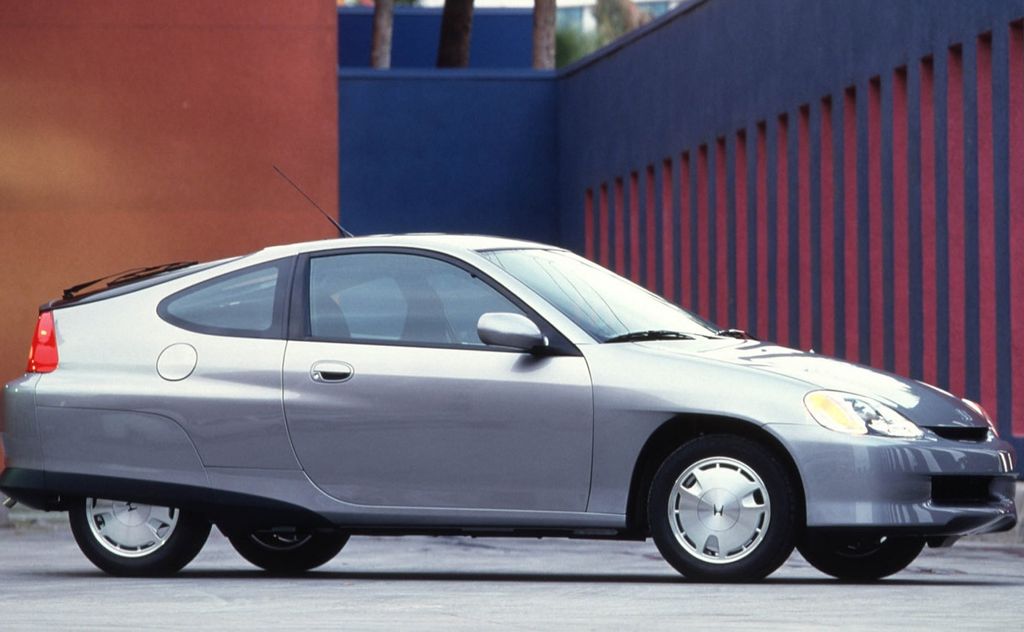
Honda, meanwhile, makes only one hybrid SUV, the CR-V. It has the Accord, Civic, and Prelude hybrids, too, but the market has given up on sedans. The mere idea of a $45,000 hybrid Prelude coupe is absurd on its face in this market, especially when the company fails to offer electrified options in more important segments.
Its largest and dirtiest vehicles still come exclusively with naturally aspirated V-6 engines, which trace their origins 20 years back. Toyota has been making hybrid Highlanders for 20 years, but you still can’t get a Pilot or Passport with a traction battery. The Toyota Sienna minivan is hybrid only; the Odyssey is not available as a hybrid, either. Hyundai, Kia, Chrysler, and Jeep have managed to introduce hybrids into these segments, despite Honda’s decade-long head start. (A spokesperson for Honda confirmed that larger hybrids will begin to arrive in 2027, and the restructuring of the EV business will free up more money to invest in hybrids). It is also hard to buy Honda’s argument that it is driven by customer demand, considering it recently put a bunch of effort into developing a $43,000 hybrid two-door coupe. This was certainly far cheaper to develop than an EV, but it makes the company look a bit distracted by low-volume vanity products. Photo by: Honda
Meanwhile, Acura—one of the first luxury automakers to offer hybrids—pivoted its strategy last decade, saying it would “skip” the hybrid era in favor of leading the charge on EVs. Its first EV, the ZDX, not launched until 2024, was a reskinned Cadillac. It lasted less than two years on the market. Its second EV was supposed to be the RSX, and now it is dead.
That leaves Acura as one of only two brands in the U.S. without a single electrified model. Alfa Romeo is the other, which ain’t the type of company I’d keep in this business. It won’t have any hybrids until a new RDX arrives in a few years. Even Ram makes mild hybrids and has an EREV coming. Cadillac—which never traded in efficiency—has lapped them on EVs and beat out even the Germans. Meanwhile Ferrari, Lamborghini, McLaren, and Bentley all offer hybrids, showing that they’re more engaged in an electrified future than Acura, the flagship brand of one of the hybrid pioneers. What a joke.
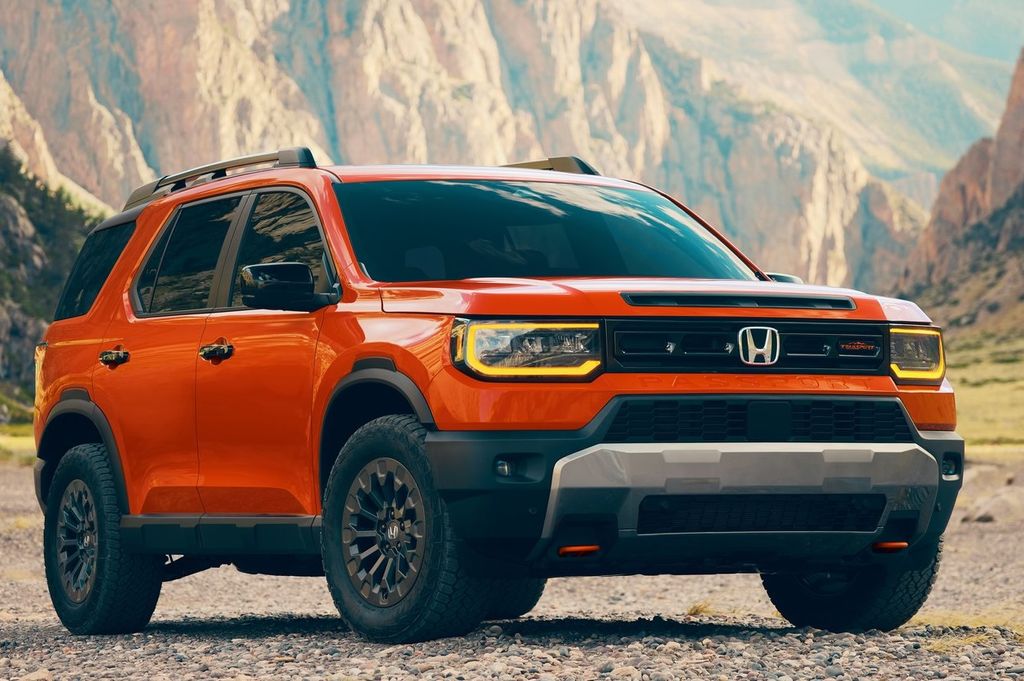
The new Honda Passport is a great product. But for a company that has long said it would prioritize profitable hybrids over money-losing EVs, it’s weird that its flagship products all come with naturally aspirated, old-school V-6s. A larger Honda hybrid platform is due in 2027.
Photo by: Honda
Against this backdrop of constantly canceled EVs, Honda, too, has never stopped burning cash on pie-in-the-sky hydrogen projects. Its newest CR-V e:FCEV is somehow the automaker’s only plug-in hybrid in this market, but it runs on a fuel you can pretty much only get in California. While it cancels EVs because of falling demand, Honda insists on building absurdly impractical hydrogen experiments as learning projects. You can see clearly, then, what it looks like when this company actually believes in a technology, damn the haters. Meanwhile on, EVs, it consistently does the bare minimum required by law.
Its strategy in this much larger and more vital market has been to sit aside and wait for the technology to improve and costs to come down. It may sound smart to some, but remember that technology does not improve on its own. It requires investment, it requires trial and error, and it requires some semblance of effort.
You can’t master the most important technological revolution in the last hundred years of cars merely by watching. Learning and competing both require actual effort, and active participation. If you only learn by what others do, you’ll always be behind them. Hopefully Honda learned some tough ones from the 0 Series before scrapping it altogether.
Empty Promises
I don’t know what Honda does next. All I ask is that the company doesn’t tell me until it’s ready to put something real on sale.
I have been told for years, to my face, that Honda is committed to EVs and carbon neutrality. It’s right there in the press release announcing yet another retreat, its third or fourth, without a single real offensive to buoy hope:
“Previously, with stringent environmental regulations fully implemented in the U.S. and other countries, Honda pursued EV adoption with strong determination that striving for carbon neutrality is a responsibility Honda, as a manufacturer of mobility products, must fulfill for the future. However, in the U.S., the expansion of the EV market has slowed down due to several factors including the easing of fossil fuel regulations and revisions to EV incentives.”
Let me translate: “We believed it was our duty to do this, back when the government required us to do it. Now that they don’t, kick rocks.” I say the same to Honda. From the decade-long saga of teasing a new NSX, to a decade-long saga of saying “this time, we’re really serious about EVs,” the company has a terrible habit of building hype for nonexistent products. Three years ago they heavily implied to me that an electric S2000 and an electric NSX were both in the works. Now we can’t even get a replacement-level electric crossover. I am exhausted. I am out of hope. I feel lied to. Back in 2022, a Honda PR person showed me this teaser for upcoming EVs, noting that one looked like an S2000, and one like an NSX. That wasn’t a coincidence, they said. I should have known better than to believe the company would build either. Photo by: Honda
I don’t want to hear about another theoretical plan to maybe eventually make an EV if things work out. I don’t want more teasers of sports cars and promises of affordable EVs that aren’t even in the prototype phase yet. Honda fans deserve something real. Put up, or for the love of God, shut up.
Forgive the anger here. But this is just a heartbreaking turn for a company that built its empire on disrupting the complacent, fuel-guzzling American giants in the ‘70s. Back then, it proved that if the big, lazy incumbents didn’t provide the cost-effective, efficient vehicles customers needed, sharper, leaner upstarts would come in and eat their lunch. As EV sales continue to grow worldwide, led by new players like BYD and Tesla, the world has learned that lesson all over again.
Well, most of the world has. Honda hasn’t. And while this current failure will cost the company up to $15.7 billion, including charges related to its China business slowing and cancelling the ZDX, RSX, and 0 Series, that’s nothing compared to what it stands to lose if it keeps dithering around. It needs to get serious, or it’ll be replaced by a company that is.
Contact the author: Mack.Hogan@insideevs.com. Related Stories We want your opinion! What would you like to see on Insideevs.com? – The InsideEVs team
