Autobayng News Team

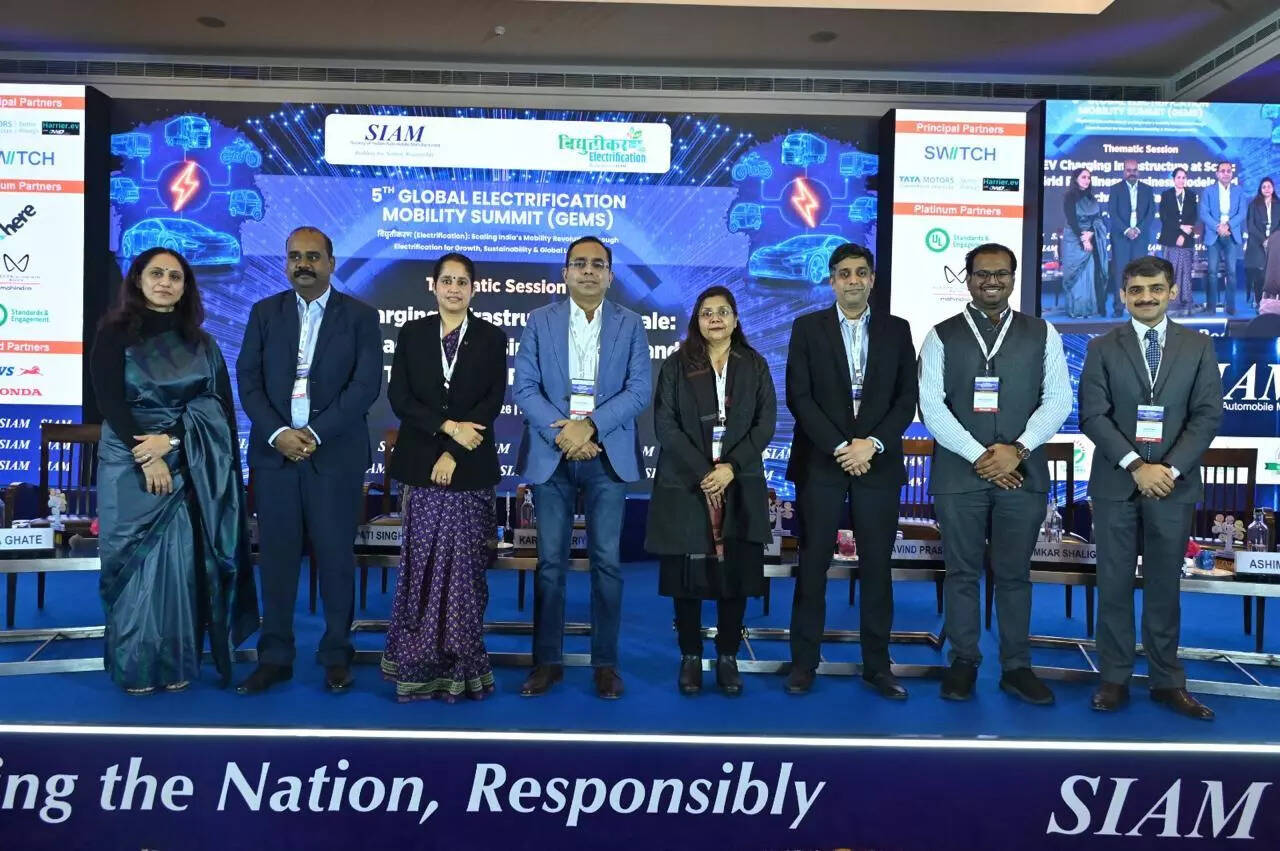
Infrastructure readiness and power economics will shape India’s journey of electrification more than vehicle technology itself, industry leaders said at the 5th Global Electrification Mobility Summit (GEMS) organised by the Society of Indian Automobile Manufacturers (SIAM) on Tuesday in New Delhi.
Following a presentation by Ashim Sharma, Senior Partner, NRI Consulting, panellists emphasised that charging infrastructure must evolve alongside urban development and power systems.
Bottlenecks in commercial electrification
Highlighting the bottlenecks faced by the sector, Kartike Hariyani, Founder & CEO, Chargezone, said commercial EV charging continues to face systemic challenges, particularly around tariff structures.“One real challenge that needs to be solved is demand charges,” he said, noting that existing tariffs were designed for industrial users with high utilisation levels rather than EV charging stations with uneven demand.Hariyani added that high electricity tariffs directly impact the total cost of ownership of commercial EVs, weakening the business case for electrification in buses, trucks and light commercial vehicles.
Need for better planning
Aravind Prasad, Head – Charging Infrastructure, Ather Energy, said two-wheelers and three-wheelers will continue to drive EV adoption in India, making their charging ecosystem critical.“The biggest shift for customers is their relationship with energy—how they access and use it,” he said, adding that home charging will remain dominant, while public and fast charging will grow in importance.
Vinoth Kumar, Head of Strategy & Planning, SWITCH Mobility, said electric buses place significant demand on the grid due to high battery capacity and long operating cycles.
“If we reach 50,000 electric buses, they alone will consume close to 15 gigawatt of energy,” he said, underscoring the need for coordinated grid and depot planning.
Kiran Gupta, Chief – Customer Experience, Commercial, Govt. Affairs, EAC & Consumer Litigation, Tata Power Delhi Distribution Limited, said EV-related load growth is fundamentally different from conventional demand.
“This is not routine load growth; there is clustering and unpredictability,” she said, highlighting the need for better planning, smart metering and regulatory support.
Standards and ecosystem alignment
Swati Singh, Head of Regional Standards, South Asia, UL Standards and Engagements, said India’s ambition to become a global hub for EV and charging equipment manufacturing will depend on early alignment with global standards.
Omkar Shaligram, Tata Motors, said India’s electrification journey will require coordinated action across OEMs, utilities, infrastructure providers and policymakers.
Panellists broadly agreed that the next phase of India’s EV transition will be shaped less by vehicle launches and more by how effectively the country addresses challenges around grid capacity, pricing structures, urban planning and standards.
Join the community of 2M+ industry professionals.
Subscribe to Newsletter to get latest insights & analysis in your inbox.
All about ETAuto industry right on your smartphone!
- Download the ETAuto App and get the Realtime updates and Save your favourite articles.