Autobayng News Team

Fifteen years after its founding, California-based QuantumScape believes it has cracked the code to solid-state batteries. Roughly the size and shape of a silvery deck of cards, the company’s anode-free, lithium-metal cells promise to address virtually all of the shortcomings of today’s lithium-ion batteries. That means higher energy density, quicker charging, more power, safer operation and, theoretically, vastly better electric vehicles.
Now comes the next big challenge: proving that its batteries can be cranked out at scale.
On Wednesday, QuantumScape took a significant step toward commercializing its tech by kicking off pilot battery production at its San Jose offices. “This is our Kitty Hawk moment,” QuantumScape CEO Siva Sivaram said on stage at an event marking the launch of the so-called “Eagle Line.” “This is our Apollo mission launch.”


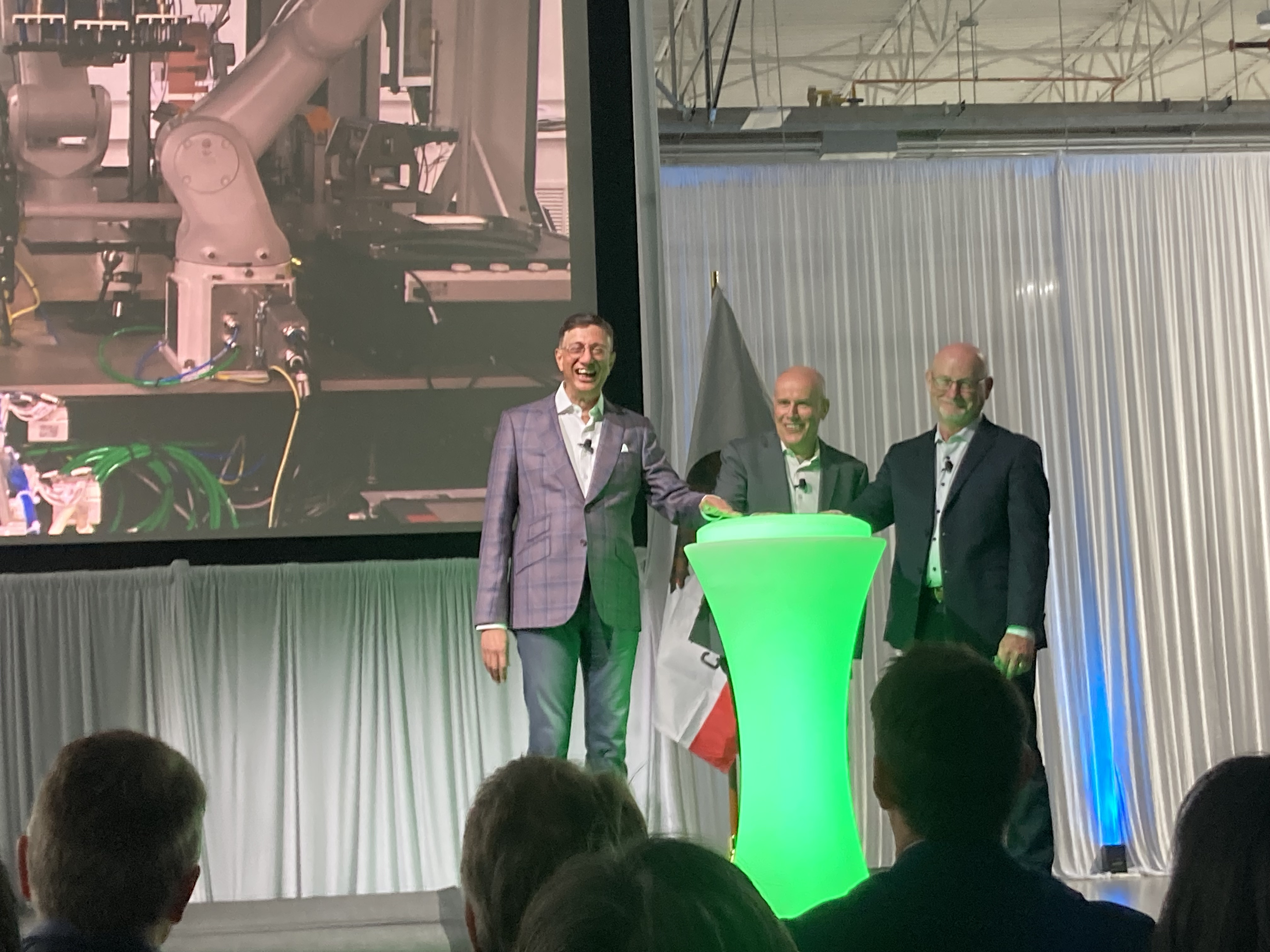
QuantumScape CEO Siva Sivaram and other executives officially inaugurate the Eagle line in San Jose.
Photo by: Tim Levin/InsideEVs
Now that QuantumScape cells are being made on an automated production line—it won’t say precisely at what volume—the company’s tech has graduated from an interesting lab experiment to something verging on an actual product. Companies large and small have dumped enormous resources into developing solid-state batteries over the years, but none have managed to mass-produce them.
Some semi-solid-state vehicles, which trade a traditional battery’s liquid electrolyte for a more stable gel, are available in China. And they’re supposed to be on the way in the U.S., too, by way of startups like Factorial Energy. No company has put true solid-state batteries—which promise even greater performance and safety benefits—into cars people can actually buy.
Solid-State Batteries, Explained
QuantumScape has serious work ahead of it before that can happen, CTO and cofounder Tim Holme told InsideEVs in an interview. But the company envisions its batteries hitting low-volume, high-performance vehicles by the end of the decade. And, eventually, products from household robots to stationary energy storage systems.
“Batteries are coming online everywhere,” he said. “The long-term vision is [that QuantumScape becomes] competitive in a lot of big markets.”
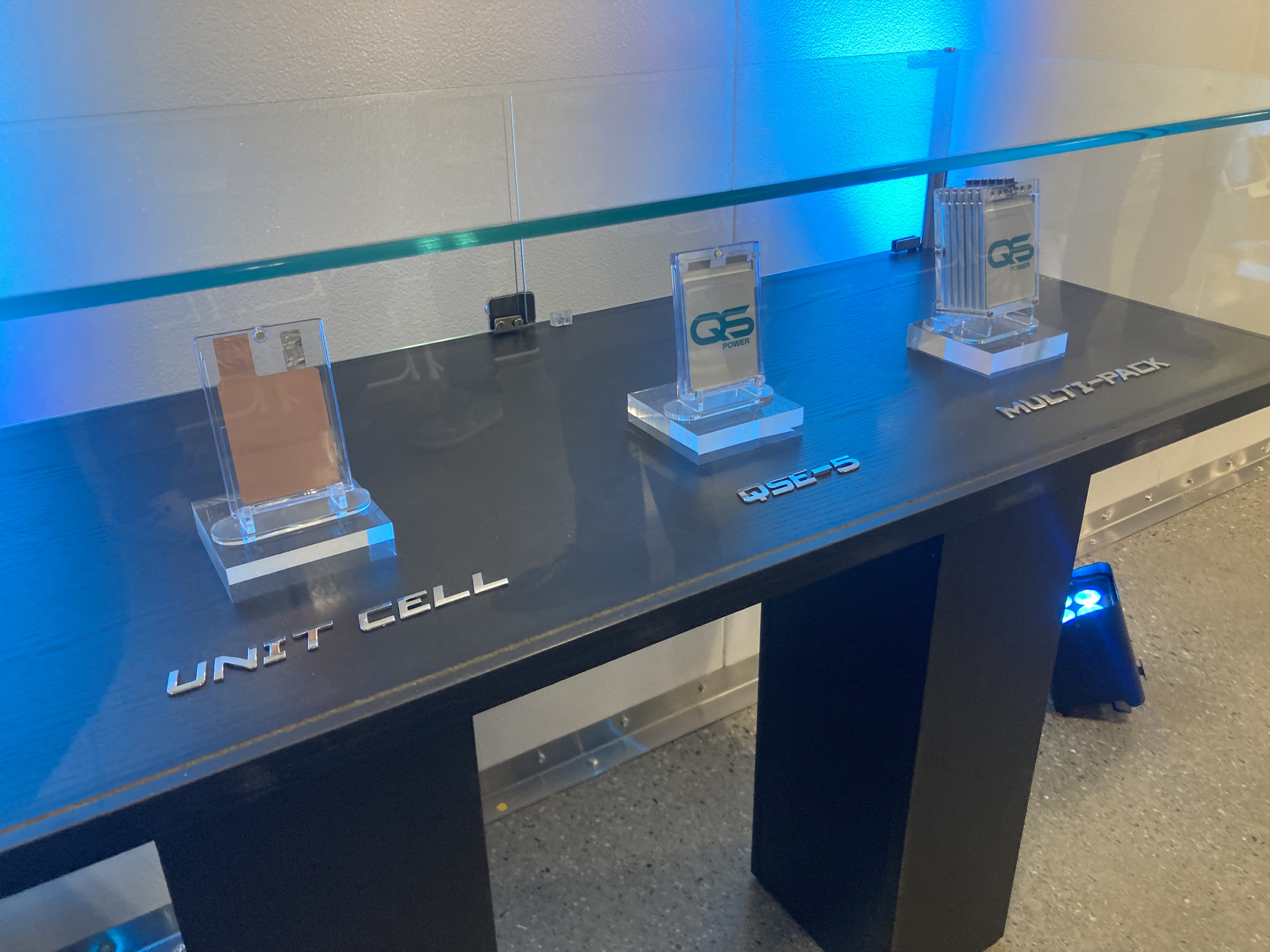
QuantumScape’s batteries are anode-free, lithium-metal cells that use a special ceramic separator.
Photo by: Tim Levin/InsideEVs
On the Eagle line, nickel-based cathodes and ceramic separators are laminated together to form paper-thin “unit cells,” which are then stacked and packaged to create the 5-amp-hour batteries that are QuantumScape’s first planned commercial product. It all happens inside of rectangular, refrigerator-tall machinery humming behind clean-room glass.
In the immediate term, the plan is to keep close tabs on how the line is doing—its output, its yield, its uptime—and on the quality of the batteries it’s spitting out, Holme said. The point isn’t to eventually ramp up to huge volumes, but rather to show customers that it can be done.
This is because QuantumScape envisions a licensing business, not a manufacturing one. Officials say the goal isn’t to become a mass-producer of solid-state batteries, but for automakers and other companies to do that themselves using its IP.
Importantly, the prototype factory also gives both QuantumScape and its potential customers a lot more batteries to work with, test and learn from.
“I can’t tell you how important it is to actually begin to have a higher volume of cells,” said Asim Hussain, the company’s chief business development and marketing officer. “One of the key intentions of the line is to create a repeatable manufacturing process, but also to mature our customer relationships by providing more technology to them. As a licensing company, that’s absolutely critical.”

QuantumScape installed its batteries in a Ducati motorcycle last year, in the first real-world demonstration of its solid-state technology.
Photo by: Ducati
Volkswagen is a significant backer, and the two companies rolled out a demonstration vehicle, a Ducati motorcycle with QuantumScape cells, at Germany’s IAA Munich auto show last year. The company has said it’s working with other unnamed large auto manufacturers as well.
QuantumScape has targets in mind for increasing the performance of the Eagle line, and it is planning upgrades to the factory, Holme said. But even getting to automated production is a big milestone, he said.
“You might recall Tesla’s manufacturing hell,” he said, referring to the famously difficult ramp-up of Model 3 production in 2018. The EV maker introduced too much automation too early and was forced to rip out the robots in favor of more human input. “If you automate too early, then the robots aren’t flexible enough to do the process you actually need, so you end up reworking, which takes a long time. It’s an important marker in the maturity of our process that we felt we knew enough to automate it,” Holme said. QuantumScape battery cells can be stacked into larger packs. Photo by: Tim Levin/InsideEVs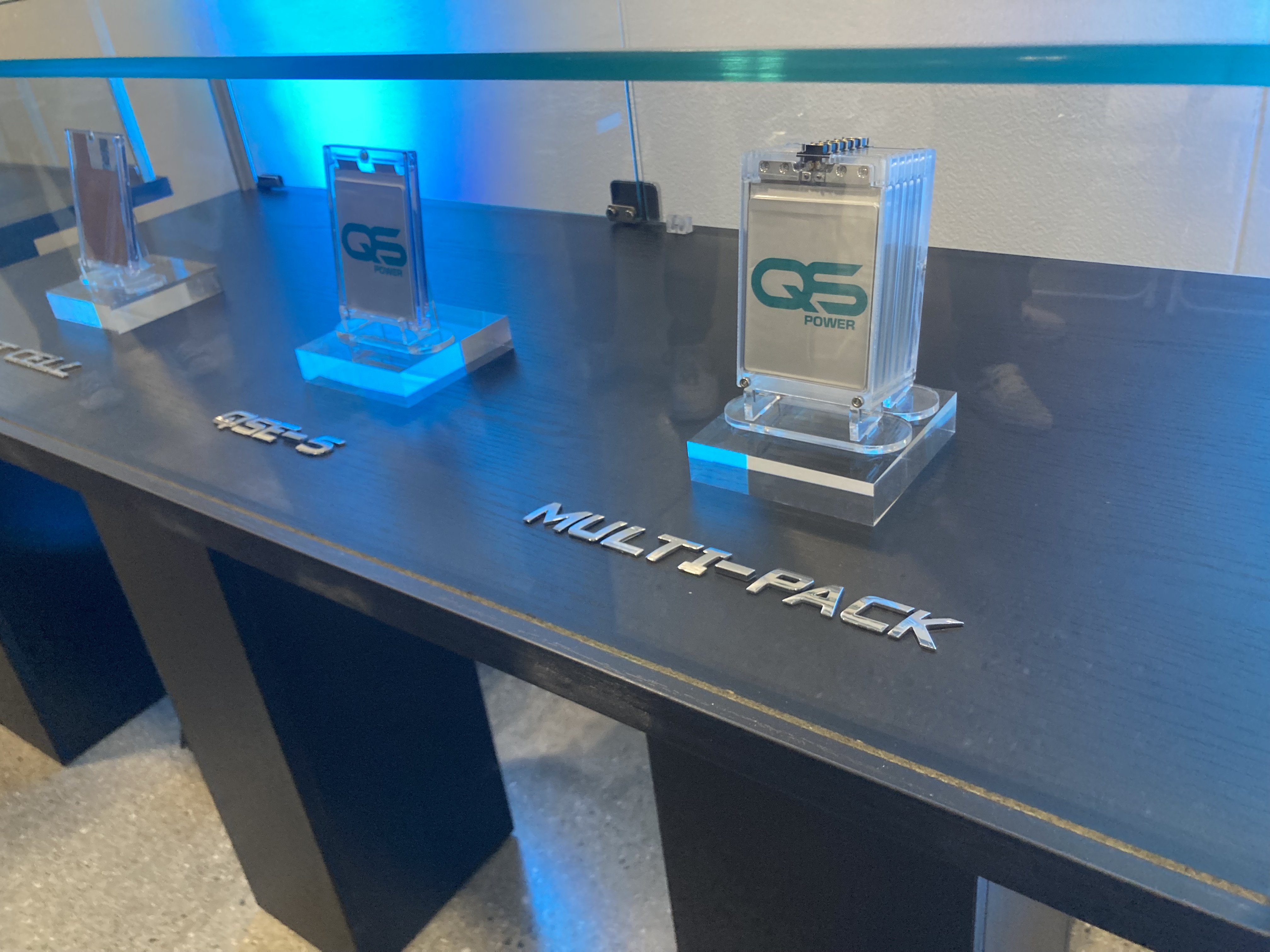
Looking out a bit further, QuantumScape plans to scale up production alongside partners and has a roadmap of cell-performance improvements it aims to hit. Regular lithium-ion batteries have gotten worlds better over the decades, and Holme expects a similar pattern for solid-state tech. He notes that the first consumer-available lithium-ion batteries—rolled out by Sony in 1991 in camcorders—had about a third the performance of today’s batteries.
“We think we’re also going to have an S-curve of improvements,” he said. “Some of them are incremental in the same way that lithium-ion did. Some of them are going to be more evolutionary with new materials or new architectures.”
That raises the question: If lithium-ion batteries are so good already, and so much cheaper than ever before, where does that leave the case for solid-state?
“The implication for us is that it’s a competitive marketplace that we need to differentiate in terms of performance,” Holme said.
The company doesn’t aim to be the cheapest out there, but Hussain added that it’ll be competitive for the performance it offers. Plus, he said, since QuantumScape’s technology uses broadly the same cathode materials as other batteries—high-nickel right now, but it can also accommodate cheaper lithium-iron-phosphate—the company can take advantage of strides in cost and scale realized across the industry.
Where will QuantumScape batteries debut first in the marketplace? According to Holme, the Ducati project shouldn’t suggest that it will be a motorcycle. He does say that the technology will probably start out in “specialized, lower volume vehicles that are ultra high-performance.”
More Battery Stories
“Just like Tesla introduced the Roadster first at high-end, but higher cost-areas, and then the Model S, and then the Model 3, I think likely new battery technologies would follow a similar pathway,” he said.
QuantumScape is eyeing more mass-market cars for battery deployment as well, Holme said. But he doesn’t think solid-state will necessarily take over everywhere. He expects lithium-ion and solid-state technology to coexist, but for different applications with different requirements.
“It’s not going to be like, one battery takes all markets,” he said. “If you look at things like stationary energy storage, they don’t really care about volume or mass. They care about cost and longevity. If you look at mobile applications, they care a lot about volume and mass.”
But while many solid-state promises have gone undelivered, the race seems to be heating up as of late. I asked Holme if he cares about being first to get solid-state batteries onto the market.
“That’s not the way I think about it. Like, who made the first smartphone? It wasn’t Apple. Who made the first social network? It wasn’t Facebook,” he said, adding that winning the battery market will mean beating competitors year after year—not once. “We want to go fast for a bunch of reasons. It’ll help our market cap, it’ll help the world to get better batteries. There’s a lot of reasons we want to go fast. But I don’t think race is the right framework.”
Contact the author: Tim.Levin@InsideEVs.com We want your opinion! What would you like to see on Insideevs.com? – The InsideEVs team