

 Autobayng News Team

2025 was a tumultuous year for the electric-vehicle space, beset on all sides by geopolitical tensions, shortages, regulatory changes and the erasure of the $7,500 tax credit. The result was the weirdest year ever for EV sales, with some brands hitting new EV sales records and canceling flagship electric models in the same breath.
The result is a reshuffled game board, with fewer players, fewer spoils and much more competition for the pool of buyers, as evidenced by this year’s Kelly Blue Book Electric Vehicle Sales Report. Total EV sales in the United States declined by 2%, even as they climbed globally. But the granular data is a lot more volatile than that, and the worst is yet to come. That’s why this is a particularly dissonant year for winners and losers: Some of the brands that posted the best U.S. EV sales gains are actually in the most trouble, and vice versa.
So what does all of this mean for the year ahead and beyond? Let’s dig in and find out.


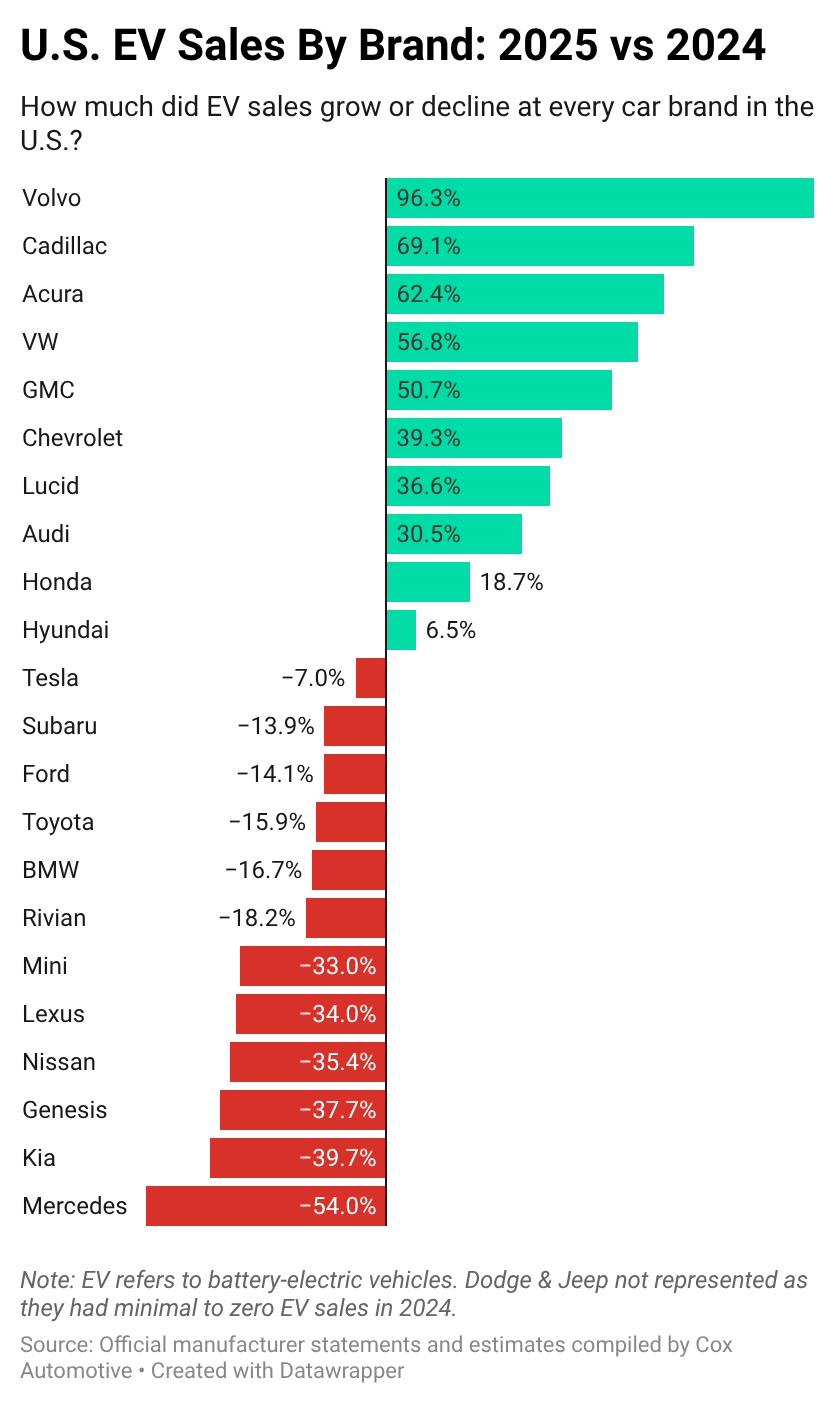
U.S. EV sales: 2025 vs. 2024
Photo by: Tim Levin/InsideEVs
Winner: Volvo

Photo by: Volvo
Volvo’s U.S. EV sales were up 96.3% for the year, to 10,821 units, according to KBB, representing astounding growth. But anyone who follows the EV industry closely knows it hasn’t been smooth sailing for the EV brand. Its EV gains are mainly driven by the EX90, its software-defined electric flagship. Far more advanced than previous Volvo EVs, it offers over 300 miles of range in a segment where Volvo consistently overperforms.
Yet the EX90 didn’t. Early examples were plagued with software issues, with many bugs surfacing during my brief first drive. Updates have improved things since, but Volvo is betting on the EX60 to reset its electric momentum. We’ll learn about that model next week.
For now, Volvo needs the win. Despite posting record EV sales in the U.S., its overall sales have been spiraling due to increased global competition, new import tariffs that affect its most profitable vehicles here and a series of headaches launching both the EX30 and EX90.
Volvo has proven it can grow EV sales here in spite of these challenges. But if it wants to be a high-volume player, it can’t afford to bungle the EX60.
Loser: Mercedes
The Mercedes EQE and EQS didn’t quite hit the mark.
Photo by: Mack Hogan/InsideEVs
While Volvo’s surprise growth hides a small overall EV business and an ongoing quality crisis, Mercedes’ sales collapse accurately captures its position. Mercedes U.S. EV sales were down 54% year over year, or 12,942 units compared to 28,154 sales in 2024. And don’t expect that to reverse immediately: The EQE and EQS sedans and SUVs have both been paused for the U.S. market, as Mercedes kills its awkwardly designed and poorly received EQ cars.
Don’t be fooled by the bad numbers and backtracking, though. This may still be a great year for Mercedes EVs. The EQ cars were compromised and middling. The new CLA is neither, with an all-new 800-volt architecture, blazing fast charging speeds, an all-new cabin experience with MB.OS and around 400 miles of range. It also looks to have one of the most advanced automated driving assistance systems you can buy right now. The GLC EV promises to bring the same improvements to the high-volume compact crossover market later this year, too, setting Mercedes up for a much-needed electric do-over. Mercedes wants to reset its EV fortunes with the new CLA. Based on our first drive, the company might have pulled it off. Photo by: Patrick George
That’s why—if this list was subjective—I’d put Mercedes on the winners list. The company got walloped by tariffs, hurt by its own middling offerings and unseated from its comfortable position in China. Yet it also proved that one mistake wouldn’t define it. After years of trying to make the EQ cars work, the company has learned its lessons and is back for another chance at the throne.
Winner: Volkswagen Group
This has been maybe the worst year ever for the Volkswagen Group, with a full-on panic about the direction of Porsche, Audi and its core brand. Part of that is that all of these companies invested heavily in EVs and planned for a quick transition, only to realize that customers remain price-sensitive and anxious.
Another part is that the company is struggling in China and has never really been a huge player in the U.S., leaving it over-exposed to the shrinking and modestly profitable European auto market. Its software plans have been rewritten more times than I can count, and its core brand’s flagship EV, the ID. Buzz, is taking a gap year to figure things out in 2026. None of this looks great.
Don’t be fooled: VW EV sales may look good, but that’s only because the ID.4 had a stop-sale order for most of 2024. We expected numbers to improve significantly in 2025.
Yet on paper, this year was a stunning success for the Group’s U.S. EV efforts. KBB data shows VW EV sales up 56.8% for the year, while Audi EV sales grew 30.5%. Sure, part of that is rising from a low bar: The ID.4, VW’s only high-volume EV, had a stop-sale recall that prevented sales for most of 2024. Yet Audi, too, posted gains, and Porsche did the best of all. EV sales for the brand climbed 117.5%, driven by the new Macan EV. Volkswagen’s next-gen EVs look a lot better inside. Photo by: Volkswagen
This year, as Porsche launches an electric Cayenne, I hope to see that number go up. But VW won’t be out of the woods until we try out its new EVs, developed with the help of its Rivian joint venture. Those products may finally offer the software experience, upgradeability and simplicity we expect from cutting-edge modern EVs.
Loser: Genesis
I like the Genesis GV60, but its awkward shape and middling range figures make it a niche player.
Photo by: Patrick George
Genesis was an early mover in the electric luxury space. Its results this year are a reminder that merely showing up isn’t good enough. While the company offered three EVs—the GV60, the Electrified GV70 and Electrified G80 (RIP)—none of them seem to be the right product at the right time. The GV70 and G80 are compromised by their gas-car foundations, and the GV60 is too small, awkward and low-range to be a do-everything luxury EV.
Couple those issues with a less-recognized brand and you get Genesis’ 2025 results: Sales fell 37.7%, to just 3,884 units for the year. The upcoming GV90 EV and GV60 Magma should help grow the company’s offerings. But if it wants to establish more of a beachhead in the EV market, the company needs a higher-volume product sooner, not later.
Winner: General Motors
General Motors has made a lot more progress on the EV transition than either of its crosstown rivals. Now the number two EV company in the country—behind Tesla, of course—it offers a stunning number of electric options. They are not typically the lightest or most cutting edge in their respective classes, but GM EVs offer solid technology and plenty of range at attractive prices. That’s why the Chevy Equinox EV was our inaugural Breakthrough EV of the Year, and why it’s the best-selling non-Tesla EV in the U.S. That helped push Chevy EV sales up 39.3% year-over-year. Cadillac launched so many new EVs last year that we struggled to keep up. We still haven’t even driven the Vistiq, the brand’s new three-row family hauler. Photo by: Cadillac
Cadillac fared even better. After decades of stagnation, Cadillac bet big on EVs, and it’s paying off. EV sales grew 69.1% in 2025, from an already high baseline. That’s made Cadillac the number one brand for luxury EVs, and made the company relevant in the luxury space for the first time in a long time. GMC, too, put up big numbers, with EV sales up 50.7% for the year.
The catch is that GM has a lot of electric truck models, and a lot of models that were selling big off of highly discounted lease deals. As the lease deals fade away in a post-tax-credit era, we’ll see if the General can keep up its momentum.
Loser: Tesla
Photo by: InsideEVs
Tesla did not post the largest EV sales decline of the year. That honor goes to Mercedes. Tesla U.S. sales were down a comparatively modest 7.0%. But I have to include Tesla here, for two reasons. The first is that, as an axiom, it is impossible to talk about the EV market without talking about Tesla. The second is that Tesla still accounts for nearly 40% of all EV sales in the U.S., so even a modest drop is huge in absolute figures.
That’s certainly true. Tesla U.S. sales fell from 633,762 in 2024 to 589,160 in 2025, despite a major update to its most popular model, the Model Y. Cybertruck sales were already down a staggering 48%, which is certainly not what you want to see in a flagship product’s second year on sale.
But the real reason it needs to be on this list isn’t in the numbers. It’s the culture. Tesla entered 2025 damaged by Elon Musk’s antics, but it was still perceived as a cool, sophisticated brand. These days, the brand is toxic, as evidenced by the stunning Tesla sales collapse we’ve seen in Europe, and the rising amount of anti-Tesla and anti-Elon sentiment I encounter online and in the real world.
It’s gotten bad enough that Elon Musk finally admitted that his pet project of personally gutting the federal government was a failure. Hopefully, in 2026, he’ll focus on cars, but so far he doesn’t seem inclined to give up his influence.
Winner: Acura
ZDX (pictured) sales may be surging, but that still wasn’t enough to save it. Acura is nixing the ZDX and replacing it with a home-grown EV on Honda’s 0 Series EV platform, the RSX.
Photo by: Acura
Here’s a weird one for you: Last year Acura EV sales grew 62.4% year over year, all on the backs of the ZDX, the brand’s sole electric model. Then, last fall, Acura axed the car.
From a distance, it looks strange. But look closer and it makes sense. The ZDX is more closely related to the Cadillac Lyriq and Chevy Blazer EV than it is to any other Acura, built by GM as part of a deal with Honda. The whole strategy ended up being a placeholder until Honda and Acuras real EVs arrive later this year.
With the RSX EV slated to launch in the second half of 2026, Acura thought the slow-selling ZDX had fulfilled its mission. With only 12,005 sales in its best-ever year, the ZDX won’t be hard for Acura to replace. Let’s hope the company’s next EV nameplate revival goes better than its last.
Loser: Kia
Kia improved the EV6 for 2025, but the closely related Hyundai Ioniq 5 still handily outsells it.
Photo by: Patrick George
Kia was an early leader on electrification, but that momentum has started to taper off. Hyundai’s Ioniq 5 has long outsold its less spacious and practical sibling, the Kia EV6, and with Hyundai’s giant U.S. EV factory finally coming online, the gap is widening.
Kia sold 33,836 EVs last year, 12,933 of which were EV6s. That’s a 39.7% year-over-year drop for the brand and a 40.4% decline in EV6 years, despite a mid-cycle refresh. Meanwhile, Hyundai’s Ioniq 5 outsold the entire Kia brand: 47,039 units last year.
Kia executives tell me that this is partially explained by the Hyundai “Metaplant” only building the Ioniq 5 and Ioniq 9 right now. Kia’s EV6 has to share factory capacity with the Telluride, Sportage, Sorento and EV9. In a year where EVs struggled, Kia leaned into its profitable gas models. But with the EV3 slated to arrive soon and the EV market heating up, I hope Kia redoubles its efforts here. I hope the Kia EV3 brings some life into Kia’s U.S. EV business this year. Photo by: InsideEVs
Conclusion
Top-line sales figures do not capture how chaotic this year was for the EV market. For the first time in modern history, auto giants had to navigate a trade and regulatory environment that was changing by the day. That uncertainty is expensive: It’s paid in extra supplier contracts, inflated prices and canceled long-term investments. Businesses need clarity to plan their next step, and when they lose it, they all end up writing off billions of dollars.
The result of this chaos for you is simple. You get higher prices, fewer choices and more carbon in the atmosphere. But those who thing a few regulatory changes will reshape the broad course of history are fools. EVs are here, and they are the endgame. The only question is how fast we get there.
Contact the author: Mack.Hogan@insideevs.com. Related Stories We want your opinion! What would you like to see on Insideevs.com? – The InsideEVs team
