Autobayng News Team


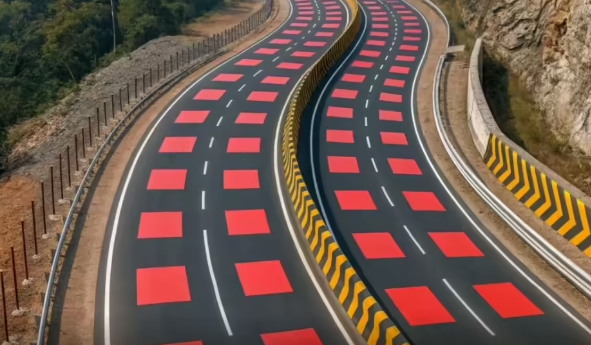
As India prepares its highways for software-driven and sensor-led vehicles, an interesting experiment unfolding in Madhya Pradesh is drawing attention from road safety experts and automotive technologists.
A two-kilometre stretch of NH-45, cutting through an ecologically sensitive forest corridor in a ghat section, has become India’s first highway to feature tabletop red thermoplastic road markings. This marks a bold attempt to blend human psychology, wildlife protection, and future ADAS (advanced driver assistance systems) compatibility.
Unlike conventional speed breakers or rumble strips, the bright red surface is slightly raised, visually dominant and deliberately designed to trigger instinctive deceleration. The objective is to reduce vehicle speeds in wildlife zones without abrupt braking, vehicle damage or driver discomfort which are seen as key contributors to animal-vehicle collisions in forested corridors.
ADAS-ready by design, not by colour alone
At a time when concerns are being raised about whether non-standard road colours could confuse (ADAS), experts point out that modern ADAS platforms do not rely on colour recognition alone. Instead, they use edge detection, contrast analysis, reflectivity, and semantic interpretation, supported by sensor fusion across cameras, radar and LiDAR.“Readiness varies by OEM and system maturity,” notes Abhishek Mohan, Chief Engineer, ADAS, Tata Technologies. From an ADAS Level 2/3 perspective, he continues, it is largely compatible, provided it does not obscure standard longitudinal lane markings.
“ADAS systems primarily rely on white and yellow lane lines for lateral control. Transverse coloured treatments like this are generally interpreted as road-surface features, not lane boundaries,” says Mohan.
In rare cases where the underlying lane paint is temporarily masked, the system may request driver takeover or disengage, which is “safe and expected” behaviour. Overall, the concept does not conflict with ADAS operation and aligns well with gradual speed-reduction strategies.”Adds Mohan, “While premium ADAS platforms are robust, roadside consistency and clear lane markings remain critical, especially for higher levels of automation. Initiatives like these should ideally be accompanied by good lane paint continuity signage and digital mapping updates to fully support future Level 3 deployments.”In this context, the red marking does not emerge as a constraint, but rather as a forward-looking infrastructure intervention, provided it is supported by high-quality lane paint continuity and proper calibration standards.
Behavioural engineering meets road safety
The choice of red is deliberate. Its long wavelength makes it more attention-grabbing than white or yellow, triggering a strong psychological response without overwhelming the driver. “Rather than being a distraction, it is intended as a “psychologically powerful” visual cue meant to trigger a driver’s instinctive reaction to decelerate,” says Vishal Gupta, Executive Director, Deloitte India.
Describing it as a “subtle nudge” — a visual warning that signals entry into a danger zone without the sudden physical jolt or potential vehicle damage caused by traditional speed breakers — he adds that the markings also help break the monotony of long drives and can reduce driver fatigue in tropical or high-traffic environments.”
Night-time performance: Reflectivity over colour
A key concern in tropical and forested highways is night-time visibility. For ADAS and human drivers alike, reflectivity and contrast matter far more than colour. Drawing inspiration from Sheikh Zayed Road in Dubai, and supported by international research and guidelines, India’s first-ever ‘table-top red marking’ on a National Highway in MP is a 5 mm thick hot-applied thermoplastic red surface layer laid across the carriageway in the identified danger zone.
“In tropical environments like India, the key factor is not the colour itself but material specification and maintenance,” says Mohan. “When high-quality thermoplastic materials with appropriate reflectivity and UV resistance are used, glare and visual discomfort are minimal. International experience shows that such markings improve driver awareness and speed discipline rather than causing distraction.”
For ADAS, night-time performance depends primarily on reflectivity and contrast, not colour. High-quality thermoplastic markings with glass beads perform well under headlamp illumination in both dry and wet conditions. Thermal night-vision systems, when fitted, are largely colour-agnostic and are intended to “detect animals or pedestrians rather than road markings themselves”.
In that sense, the tabletop red marking does not negatively impact night-vision functionality and can complement it by encouraging lower speeds in wildlife zones.”
Gupta notes that the 2 km stretch on NH-45 “glows” or shines bright red at night due to the texture of the tabletop markings, which alerts human drivers to maintain speed limits. “For ADAS, night vision systems use infrared cameras to detect objects beyond the reach of headlights,” he says.
While there is no on ground experience and data for ADAS performance on this red surface at night, Gupta says solar-powered lighting and white shoulder lines “seem to be added” to the margins of the highway to further guide vehicles and prevent them from drifting.
Lessons from Dubai, implications for India
Globally, coloured road treatments are not new. Dubai’s use of visually distinctive surfaces on Sheikh Zayed Road, particularly for caution zones and public transport lanes, has demonstrated how selective, eye-catching interventions can influence driver behaviour and reduce accident rates. The lesson is not about aesthetics, but about disciplined, purpose-driven deployment.
India’s experiment echoes this philosophy, signalling a shift from purely transport-centric highway design to a more holistic safety model, one that integrates ecology, behavioural science, and vehicle technology.
“As India continues to build critical infrastructure through diverse landscapes, this project sets a benchmark for environmentally responsible, people-centric, and wildlife-sensitive highway development, where red roads signal not danger, but thoughtful design and green intent,” says the Ministry of Road Transport & Highways in a release on PIB.
A signal to automakers and policymakers alike
As next-generation vehicles move towards higher autonomy through advanced sensor fusion, road infrastructure can no longer be treated as static.
“While next-gen vehicles rely on advanced sensor fusion (combining cameras, radar, and LiDAR), infrastructure and car manufacturers need to collaborate and adapt roads for assisted driving,” says Gupta.
A critical factor for readiness is calibration; ADAS cameras need to see the road exactly as intended to function reliably. Current research on lane detection in adverse conditions suggests that moving toward coloured markings could further facilitate driving by providing better algorithmic “peaks” for sensors to track.”
Highlighting the role of virtual validation in this transition, Azmathullah Mohammed, Senior Sales Director, Customer Solution Experience, Dassault Systèmes India, points to the importance of simulation-led development.
“CATIA SCANeR plays a crucial role in ADAS development by enabling engineers to simulate and validate real-world driving scenarios in a virtual environment. It allows modelling of scenes, vehicles, sensors, and software, providing a high-fidelity 3D simulation platform where ADAS functions can be tested under various conditions, such as different road layouts, weather, and traffic situations,” he continues.
This helps in evaluating sensor placement, system performance, and human factors before physical prototypes are built, accelerating the design and validation process.”
MP’s NH45 pilot sends a clear message: future-ready highways must evolve alongside vehicles. More than just a road safety measure, India’s first tabletop red marking represents a new design language for highways, one that protects wildlife, sharpens driver attention, and quietly prepares the ground for a more automated future.
Join the community of 2M+ industry professionals.
Subscribe to Newsletter to get latest insights & analysis in your inbox.
All about ETAuto industry right on your smartphone!
- Download the ETAuto App and get the Realtime updates and Save your favourite articles.