

 Autobayng News Team

Winning the world’s health lottery is a lonely business in the current climate. “It’s like being an orphan in a space where there used to be many kids playing – suddenly everybody’s gone and you’re just there with a ball,” says Dr Christian Happi.
The Cameroonian distinguished professor of molecular biology and genomics has just won $100m for his work – at a time when global health funding is being viciously slashed as part of wider aid cuts.
“It gets very lonely when you have this type of resource, and then around you, your colleagues have nothing to do, don’t have resources to work and are closing down labs,” says the 57-year-old from his office at Redeemer’s University in Ede, Nigeria.


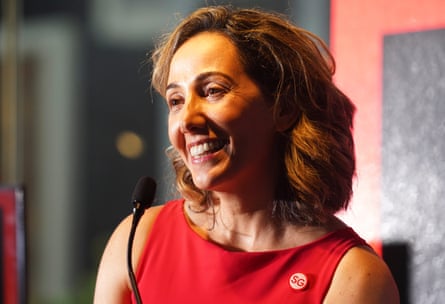
Awarded every four years by the US MacArthur foundation to an initiative “that promises real and measurable progress in solving a critical problem of our time”, the grant honours Happi and his co-founder, computational geneticist Dr Pardis Sabeti, who have already saved an uncountable number of lives. Together they have helped identify, and therefore stem, potentially disastrous outbreaks of yellow fever in Nigeria, mpox in Sierra Leone and Marburg virus in Rwanda.
Few people have heard of Happi and Sabeti, yet they not only run a virus detection network to stop the next deadly pandemic but are also breaking down inequity between Africa and the global north by empowering African scientists to improve African lives.
Their project, Sentinel, is an early warning framework co-created by Nigeria’s Institute of Genomics and Global Health and the Broad Institute of MIT and Harvard. Housed inside the African Centre of Excellence for Genomics of Infectious Diseases (ACEGID), the programme uses genomics, surveillance and sequencing technology to identify new pathogens and then packages the science so it is ready-made for governments to act on. Since its inception, Sentinel – initially funded by a TED-Audacious Project grant – has proved an extraordinarily effective idea, says its managing director, Dr Al Ozonoff.
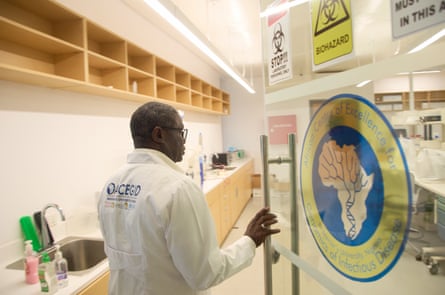
While Happi’s work responding to critical outbreaks has saved lives, just as important, Ozonoff believes, is his “vision of African scientists working at the cutting edge of their fields to improve life for everyday Africans”.
Sentinel has trained more than 3,000 health professionals across 53 of Africa’s 54 countries in genomics so they too are better able to track, identify and respond to outbreaks.
In light of global aid cuts, Happi had been worried about Sentinel’s survival. Development assistance for health is estimated to drop to $39.1bn by the end of 2025 as the US, UK and other countries reduce their overseas development funding. The MacArthur grant will allow Sentinel to train more academics and health professionals in harder to reach places.
Happi, who starts each day with a prayer and a walk, recalls the first time he put the idea behind Sentinel to good use. It was 2014 and he got the middle-of-the-night phone call that, he says, “you never want to receive”. It was Nigeria’s ministry of health. There was a suspected case of Ebola in Lagos. Could he confirm it?
“I got chills, goose pimples. I prayed that wasn’t going to be the case,” he says.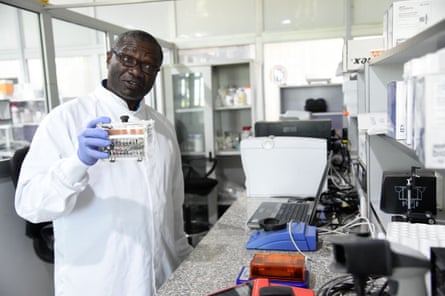
Happi drove to his rudimentary, at the time, two-room laboratory on Redeemer’s University campus, where he remains a professor, and said goodbye to his wife, Dr Anise Happi, deputy director of zoonotic research and surveillance at ACEGID.
Ebola, which within two years would kill more than 11,325 people in west Africa, had already claimed the lives of many healthcare workers. He did not know if he would see Anise or their three children again. “She told me: ‘I will pray for you. I know you’ll be back,’” Happi recalls.
Working through the heat of the night, sodden in their own sweat and exposed to the deadly infection they were testing, Happi and his assistant were able to confirm within a matter of hours that Ebola had arrived in Nigeria. The country mobilised. Just 42 days later, Nigeria was able to declar itself Ebola free. Out of the confirmed 20 cases, eight people died. Each death a tragedy, but nothing like the scale that could have faced the country of 186 million people.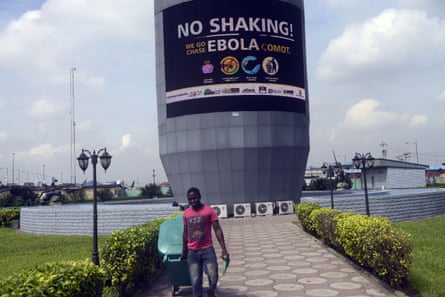
This demonstrated for the first time that Sentinel was “a transformational system”, says Happi, explaining that its speed and effectiveness helped to mobilise a response swiftly. From there, the idea – detection of pathogenic threats in real time while stopping diseases before they spread – grew. Build Health International (BHI), a non-profit that builds infrastructure in low-resource settings, upgraded Happi and Sabeti’s little lab to a state-of-the-art genomics centre – this time with air conditioning – and by 2020, when Covid hit, the team was well equipped to have the full genome within 48 hours of the first case arriving in Nigeria. Sentinel later detected the Beta and Omicron variants.
It wasn’t always easy. Trying to build a genomics centre in rural Nigeria where energy supplies aren’t stable and equipment is costly to import was tough, says Jim Ansara, co-founder of BHI. But Happi was “always pushing”, steadfast in his belief that Africa shouldn’t have to settle for less than the global north, Ansara says. “He’s quite unusual because he is very entrepreneurial, very driven and almost impatient for results.”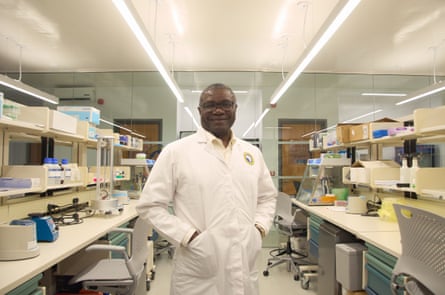
Born the fourth of eight children in Sangmélima, Cameroon, Happi went to Yaoundé University, Cameroon, then studied in Nigeria and the US. He was described as a “force of nature” when he was named one of Time magazine’s 100 most influential people of 2025.
“I don’t even subscribe to Time,” Happi laughs. When it came to the MacArthur grant, however, a competition that involved an application process, the team knew they were one of five finalists, but winning in November still came as a surprise.
“My heartbeat accelerated so much that I couldn’t open my mouth. It was a shock,” he says. “I never dreamed that in my career I would have this kind of money at once.”
When Happi called Ansara, his words were simple: “Get ready,” says Ansara – a nod to the infrastructure that may be needed as part of Sentinel’s mission to train more scientists and embed pandemic preparedness in public health systems.
“We are not going to be judged by just the fact that we got this money but [for] what we do with this money,” says Happi, who says it is time to put “500%” into the work. He and Sabeti have undoubtedly saved thousands of lives but he remains humble and focused on the lives still to save.

The grant “will be foundational in sustaining [Happi’s] efforts to develop genomics capability on the African continent and to use that in the detection and prevention of infectious diseases,” says Dyann Wirth, professor at the Harvard TH Chan School of Public Health where Happi is an adjunct professor of infectious diseases.
But Sentinel will still be dampened by the wider effects of global aid cuts, Happi says: “In order to tie a parcel you need many hands.”
Emerging diseases are that parcel, and with reduced funding, the hands are falling away. The Sentinel team, he says, will therefore be looking to collaborate with other organisations as part of its expansion. He has already, says Ansara, surrounded himself with young Africans committed to this work, helping to “break apart the legacy of colonialism and aid from the global north”.
With $100m in the mission’s pocket, Happi is infused with a sense of urgency, although he has promised his family he’ll take a break over Christmas and put away what the other Dr Happi, his partner Anise, calls “his second wife”, AKA his laptop.
“I promised them I am going to just make them a priority,” says Happi. “I’ll do exactly that.”
