

 Autobayng News Team

The Tesla Model S was an EV pioneer in so many ways. It proved that electric cars could be cool. Its performance put even the flashiest gas-powered supercars to shame. It was the first software-defined vehicle. It’s where Tesla first debuted Autopilot, the precursor to Elon Musk’s current autonomous-vehicle ambitions. And it made 300 miles of EPA-rated range a reality at a time when non-Teslas were largely stuck in double digits.
Since the $135,000 Model S P100D first cracked that barrier in 2016, 300 miles of range has been democratized, a testament to how rapidly EV technology has evolved as battery costs have plummeted.
The Rise Of The 300-Mile EV
There were 43 2025-model-year EVs on sale in America that met or exceeded that benchmark, up from just four in 2020, according to an InsideEVs analysis. Looking out a bit farther, we project that there will be 60 300-mile EVs on sale in the United States by the end of this year, assuming manufacturers stick to their current plans.


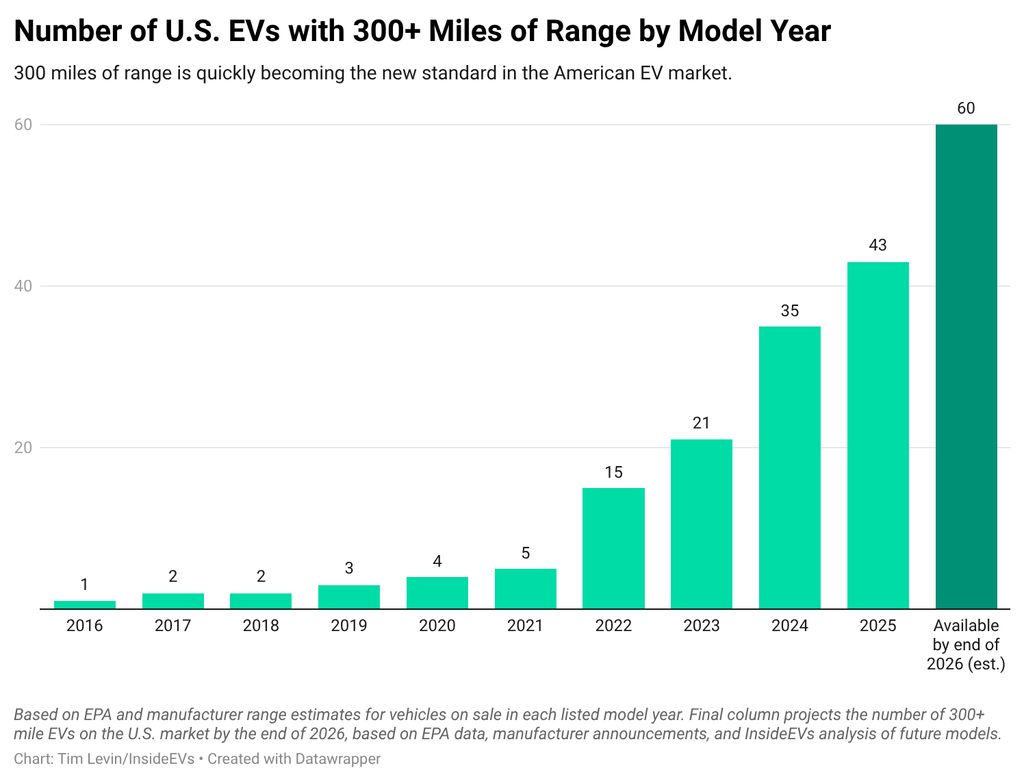
The assortment of 300-mile EVs has skyrocketed in the modern EV era.
Photo by: Tim Levin/InsideEVs
While a stunning number of EVs have been canceled or delayed in recent months, the launch of new ones such as the Rivian R2, Mercedes-Benz GLC, and Lexus ES means that the selection of long-range models will continue to grow this year. Over the years, automakers have boosted ranges of their existing models to keep up with the times too. The Porsche Taycan debuted in 2019 with just over 200 miles of range; now it has up to 318 miles. For its first few years on the market, the Toyota bZ4X topped out at 252 miles; the updated model lifted that to 314. The 2026 Rivian R2 is one of many new EVs launching this year that offers over 300 miles of range. Photo by: Patrick George
The entry price for a new 300-mile model is also lower than ever. That number has dropped dramatically as EV makers have scaled up their operations and as more affordable options have come online. The first big step change was when the Tesla Model 3 went on sale in 2017 for $44,000, cutting the price for a 300-mile electric car by tens of thousands of dollars overnight.
The 2024 Chevy Equinox EV marked another milestone, offering 319 miles for $33,495 before destination fees. Back then, you could get it for well under $30,000 with the federal tax credit included. The overhauled 2026 Nissan Leaf recently upped the ante again, hitting the market late last year with a starting price of $29,990 for 303 miles of EPA-estimated range.
Accounting for inflation, the entry price for a 300-mile EV has been roughly cut in half since the 2017 Model 3 arrived at nearly $60,000 in 2026 dollars. There are more 300-mile options under $40,000 than ever, including the new Subaru Uncharted, the heavily discounted Hyundai Ioniq 5, and the $36,990 Tesla Model 3. As a result, a broader swath of the American public can find a long-range EV that meets their budget and preferences. The 2026 Nissan Leaf dropped the entry price for a 300-mile EV to a new low of roughly $30,000. Photo by: Kevin Williams/InsideEVs
Is 400 Miles Next?
At least 300 miles of range is quickly becoming the new baseline across the EV spectrum as input costs come down and as consumers vote with their wallets. Will 400 miles follow the same trajectory toward ubiquity? That’s not as obvious. But that story, too, started with the Model S.
In 2020, it became the first EV to garner a 400-plus-mile rating from the EPA. The Lucid Air raised the bar higher in 2021 by breaking the 500-mile threshold, a sure sign that the industry is not standing still. Today the selection remains limited, and eight EVs have EPA or manufacturer ratings of 400 miles or higher. There are signs that things are changing, though.
Historically, 400-mile EVs have fallen into two categories: large luxury sedans with great aerodynamics (Air, Model S) or large SUVs and pickup trucks that were able to accommodate enormous, expensive batteries (Cadillac Escalade IQ, Rivian R1S, Chevrolet Silverado EV). Price-wise, all have landed deep in luxury territory. This category has not had a Model 3 or Equinox moment that catapults 400 miles into the mainstream.
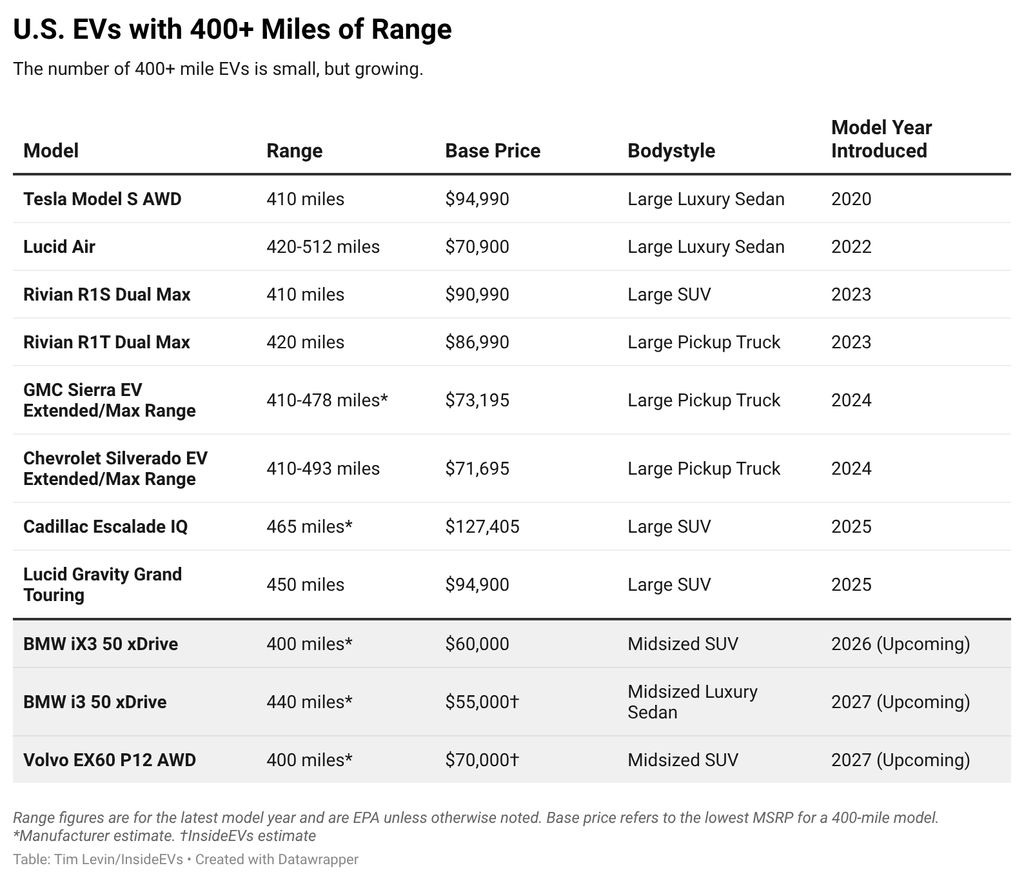
400 miles of range is trickling down in price and outward into new segments.
Photo by: Tim Levin/InsideEVs
Notably, smaller, less expensive vehicles that don’t fit that exact mold are beginning to hit the 400-mile mark. That suggests a turning point. The BMW iX3 and Volvo EX60, two midsized SUVs targeting the sweet spot of the American car market, are on pace to have 400-mile estimates when they go on sale later this year, their manufacturers say. BMW says the iX3 will cost $60,000, while we expect the 400-mile EX60 to run you more like $70,000.
The 2027 BMW i3, an electric version of the vaunted 3 Series, will deliver an impressive 440 miles on the EPA cycle, the company says. Pricing isn’t public yet, but we estimate that model to cost around $55,000 when it lands in the U.S. in 2027.
The upcoming BMW i3 sedan will have 440 miles of EPA-estimated range, the automaker says.
Photo by: BMW
All three use novel battery layouts that save weight and boost energy density. They adopt a cell-to-pack approach that sees cells installed directly into the pack casing, eliminating smaller module structures. They also use the pack as the floor of the vehicle. All of that contributes to the long range ratings.
Will 400-mile tech eventually become as commonplace and affordable as a 300-mile rating is today? The same forces that made 300 miles mainstream are still in play, like competition between brands, battery-tech improvements, efficiency gains across vehicle systems, and sliding battery costs. That suggests the capability will become more common, especially in higher-end segments where buyers are willing to pay extra for top-of-the-line features. The Lucid Air has been America’s range king since 2021, with up to 512 miles available in the latest model. Photo by: Lucid Motors
A handful of factors will determine how quickly that happens, though, and how widespread 400-mile technology ultimately becomes. For one: How quickly do automakers selling in the U.S. continue to register savings on battery cost? As the industry reaches higher levels of scale, battery costs are dropping much more slowly on a year-over-year basis than they did a decade ago, according to BloombergNEF.
A push for more range is also in tension with the need for more lower-priced models. Global EV battery costs are declining in large part due to the growth of lithium-iron-phosphate chemistry, or LFP. LFP batteries are cheaper and more durable, but not as energy-dense as the high-nickel cells that have dominated thus far. It points to a potential divide in the EV market of the future, where lower-end vehicles use LFP and consequently don’t offer tons of range—while more expensive vehicles use higher-end chemistries that are more likely to provide 400-plus miles.
There are packaging limitations as well. Cramming 400 miles of range into something the size of a Nissan Leaf or Chevy Equinox may require further breakthroughs in battery energy density. That could come from improvements to conventional lithium-ion chemistries, or from a wild-card technology like solid-state. While solid-state batteries will show up in very high-end vehicles first, the technology could shift the range paradigm over time.
The 2026 Cadillac Escalade IQ has 465 miles of GM-estimated range thanks to an enormous, 205-kilowatt-hour battery pack.
Photo by: Patrick George
There’s also the question of how much range people actually need, and how much those preferences change over time. The auto and charging industries are in the midst of a serious push to make recharging both faster and more convenient. BYD recently unveiled cars that can recharge from 10% to nearly full in a previously unthinkable 10 minutes. And the U.S. fast-charging network grew by 30% last year, according to Paren. In a future with plugs on every street corner and EVs that match gas-car refueling times, people may not feel the need for a huge range buffer.
The fact that most of the market has coalesced around 300 miles of range indicates that that’s plenty for many EV buyers to feel peace of mind, even without massive technological leaps. Lucid Motors, the country’s range champion, has sold a 500-mile-range sedan for years, but the Air is not exactly burning up the sales charts. And Tesla sells hundreds of thousands of Model 3s and Model Ys each year, with ranges spanning 321 miles to 363 miles.
The average American drives around 30 miles each day, meaning they’d only need to recharge a 300-mile-range EV about once a week (assuming they are not depleting to zero or charging up to 100%, which most EV manufacturers don’t recommend). The upper end of a car’s range really only comes into play on rare, longer trips. And even then, 400 miles may well be overkill—especially in a car that charges quickly. The sweet spot for most people is probably somewhere between 300 and 400 miles.
A 300-ish mile EV with decent charging speeds can drive for at least a few hours at highway speeds, stop for around 20 or 30 minutes, then do it all over again. For anybody who only takes long road trips a couple of times per year, it may not be worth spending thousands more to get a giant battery with extra range just to save 10 or 20 minutes at the charging station.
There’s one final wild card to consider, and it’s a powerful one: Car buyers don’t buy for the day-to-day, they buy for the “what if?” scenario. That’s how you end up with highways packed with F-150s and Tahoes carrying one or two people. Americans tend to buy the most car they can possibly get within their monthly budget—and often, outside of it—and that appetite for more certainly applies to range, too. That’s why the 400-mile EV isn’t going anywhere.
Contact the author: Tim.Levin@InsideEVs.com
More EV News
We want your opinion!
What would you like to see on Insideevs.com?
– The InsideEVs team
